Millions of Americans lose health insurance as COVID-19 era subsidies end
Volume 407, Issue 10528
7 February 2026
WORLD REPORT With the spike in Affordable Care Act health insurance costs, around 4·8 million people could lose coverage. Susan Jaffe reports from Washington, DC.
Sick of Fighting Insurers, Hospitals Offer Their Own Medicare Advantage Plans
By
Ever since Larry Wilkewitz retired more than 20 years ago from a wood products company, he’s had a commercial Medicare Advantage plan from the insurer Humana.
But two years ago, he heard about Peak Health, a new Advantage plan started by the West Virginia University Health System, where his doctors practice. It was cheaper and offered more personal attention, plus extras such as an allowance for over-the-counter pharmacy items. Those benefits are more important than ever, he said, as he’s treated for cancer.
“I decided to give it a shot,” said Wilkewitz, 79. “If I didn’t like it, I could go back to Humana or whatever after a year.” He’s sticking with Peak Health. Members of Medicare Advantage plans, a privately run alternative to the government’s Medicare program, can change plans through the end of March.
…Although hospital-owned plans are only a sliver of the Medicare Advantage market, their enrollment continues to grow, reflecting the overall increase in Advantage members. Of the 62.8 million Medicare beneficiaries eligible to join Advantage plans, 54% signed up last year, according to KFF, the health information nonprofit that includes KFF Health News. While the number of Advantage plans owned by hospital systems is relatively stable, Mass General Brigham in Boston and others are expanding their service areas and types of plan offerings.
… Medicare Advantage plans usually restrict their members to a network of doctors, hospitals, and other clinicians that have contracts with the plans to serve them. But if hospitals and plans can’t agree to renew those contracts, or when disputes flare up — often spurred by payment delays, denials, or burdensome prior authorization rules — the health care providers can drop out. These break-ups, plus planned terminations and service area cuts, forced more than 3.7 million Medicare Advantage enrollees to make a tough choice last year: find new insurance for 2026 that their doctors accept or, if possible, keep their plan but find new doctors.[Continued on KFF Health News, US News & World Report, Modern Healthcare, Medpage Today, and Fierce Health.]
Grants under threat at the US National Institutes of Health
Volume 406, Issue 10522
20 December 2025
WORLD REPORT Changes to how research grants are assessed and awarded are undermining the world’s largest public funder of biomedical research. Washington Correspondent Susan Jaffe reports.
Complaints About Gaps in Medicare Advantage Networks Are Common. Federal Enforcement Is Rare.
By
Along with the occasional aches and pains, growing older can bring surprise setbacks and serious diseases. Longtime relationships with doctors people trust often make even bad news more tolerable. Losing that support — especially during a health crisis — can be terrifying. That’s why little-known federal requirements are supposed to protect people with privately run Medicare Advantage coverage when contract disputes lead their health care providers and insurers to part ways.
But government documents obtained by KFF Health News show the agency overseeing Medicare Advantage does little to enforce long-standing rules intended to ensure about 35 million plan members can see doctors in the first place.
In response to a Freedom of Information Act request covering the past decade, the Centers for Medicare & Medicaid Services produced letters it sent to only five insurers from 2016 to 2022 after seven of their plans failed to meet provider network adequacy requirements — lapses that could, in some cases, harm patient care. [Continued on KFF Health News, CBS News, US News & World Report and MedpageToday.]
Health experts condemn US vaccine recommendations
Volume 406, Issue 10510
27 September 2025
WORLD REPORT The Advisory Committee on Vaccine Practices’ recommendations for COVID-19 vaccination prompt questions and concern. Washington Correspondent Susan Jaffe reports.
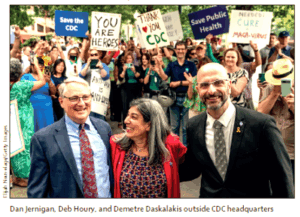
CDC is “in the ICU right now” former officials say

Volume 406, Issue 10508
13 September 2025
WORLD REPORT Senior officials say HHS Secretary Robert F Kennedy Jr is eviscerating the CDC. Washington Correspondent Susan Jaffe reports.
Millions to lose Medicaid coverage under new law
Volume 406, Issue 10500
19 July 2025
WORLD REPORT President Trump’s One Big Beautiful Bill Act makes the largest cuts to Medicaid since its creation, with doctors warning that patients will suffer. Susan Jaffe reports.

Republicans in the US Congress gave President Donald Trump his first major legislative victory, which provides the largest amount of tax and spending cuts in US history. The One Big Beautiful Bill Act (OBBB) slashes nearly $1 trillion over a decade from Medicaid—the most sweeping cuts since the health insurance programme for people with low incomes was created 60 years ago. The law will hit another historic first by taking health insurance away from more US residents than ever before—nearly 17 million, according to the Congressional Budget Office.
US Supreme Court upholds Tennessee law denying adolescents gender-affirming care
Volume 405, Issue 10497
28 June 2025
WORLD REPORT Conservative justices agreed with the state and Trump administration that banning minors’ treatment for gender dysphoria is not discriminatory. Susan Jaffe reports.
AMA protests changes to key vaccine advisory committee
Volume 405, Issue 10496
21 June 2025
WORLD REPORT The organisation, which represents more than 270 000 physicians and medical students, has
been reluctant to criticise the Trump administration’s actions, until now. Susan Jaffe reports.
When Hospitals Ditch Medicare Advantage Plans, Thousands of Members Get To Leave, Too
By
For several years, Fred Neary had been seeing five doctors at the Baylor Scott & White Health system, whose 52 hospitals serve central and northern Texas, including Neary’s home in Dallas. But in October, his Humana Medicare Advantage plan — an alternative to government-run Medicare — warned that Baylor and the insurer were fighting over a new contract. If they couldn’t reach an agreement, he’d have to find new doctors or new health insurance.
“All my medical information is with Baylor Scott & White,” said Neary, 87, who retired from a career in financial services. His doctors are a five-minute drive from his house. “After so many years, starting over with that many new doctor relationships didn’t feel like an option.”
After several anxious weeks, Neary learned Humana and Baylor were parting ways as of this year, and he was forced to choose between the two. Because the breakup happened during the annual fall enrollment period for Medicare Advantage, he was able to pick a new Advantage plan with coverage starting Jan. 1, a day after his Humana plan ended.
Other Advantage members who lose providers are not as lucky. Although disputes between health systems and insurers happen all the time, members are usually locked into their plans for the year and restricted to a network of providers, even if that network shrinks. Unless members qualify for what’s called a special enrollment period, switching plans or returning to traditional Medicare is allowed only at year’s end, with new coverage starting in January.![]()
But in the past 15 months, the Centers for Medicare & Medicaid Services, which oversees the Medicare Advantage program, has quietly offered roughly three-month special enrollment periods allowing thousands of Advantage members in at least 13 states to change plans. They were also allowed to leave Advantage plans entirely and choose traditional Medicare coverage without penalty, regardless of when they lost their providers. But even when CMS lets Advantage members leave a plan that lost a key provider, insurers can still enroll new members without telling them the network has shrunk.
…CMS would not identify plans whose members were allowed to disenroll after losing health providers. The agency also would not say whether the plans violated federal provider network rules intended to ensure that Medicare Advantage members have sufficient providers within certain distances and travel times. [Continued in KFF Health News, Fortune, MSN, Medpage Today, Boston Herald, Los Angeles Daily News, and Yahoo News.]
Trump works towards US tariffs on drug imports
Volume 405, Issue 10490
10 May 2025
WORLD REPORT Observers warn of the negative health consequences if US President Donald Trump follows through on his promise to impose tariffs on pharmaceuticals. Susan Jaffe reports.
Prescription drugs were excluded from US President Donald Trump’s tariffs that have rocked global markets and fuelled trade wars. But two recent actions signal the administration’s intention to eliminate that protection. Last month, Trump ordered the Department of Commerce to investigate whether the USA’s dependence on imported pharmaceuticals is a potential national security threat. If so, imposing tariffs would be a likely defence against imports. [Continued here.]
Can the FDA fulfil its mission with a smaller workforce?
Volume 405, Issue 10488
26 April 2025
WORLD REPORT The US Food and Drug Administration’s new commissioner promises to restore public trust despite mass layoffs. Washington Correspondent Susan Jaffe reports.
Martin Makary fielded questions for nearly 2 h from a Senate committee last month before winning approval to take the helm as commissioner at the Food and Drug Administration (FDA). His early actions have provided some additional answers about how he will likely run an agency that impacts Americans’ daily lives but is depleted by the forced departure of at least 3500 scientists and other staff. [Continued here.]
US transgender care providers face legal dilemma
Volume 405, Issue 10484
29 March 2025
WORLD REPORT Among the multitude of executive orders issued by President Donald Trump is one that creates a legal quandary for US health-care providers. Susan Jaffe reports from Washington, DC.[Continued here.]
Robert Kennedy Jr’s Promises
Volume 405, Issue 10480
1 March 2025
WORLD REPORT To earn enough Senate votes for confirmation as Secretary of the US Department of Health and Human Services (HHS), Robert F Kennedy Jr made some surprising promises for someone aspiring to become the nation’s top health official. He had to reassure a few sceptical Republican senators that he would not overturn years of accepted public health policies, medical practice, and scientific consensus. And yet, in just the short time since assuming his new post on Feb 13, Kennedy’s actions—and inaction—appear to undermine those commitments as thousands of HHS employees are laid off under President Donald Trump’s executive orders shrinking the size and cost of government. [Continued here.]