Category: Federal agencies

Sick of Fighting Insurers, Hospitals Offer Their Own Medicare Advantage Plans
By
Ever since Larry Wilkewitz retired more than 20 years ago from a wood products company, he’s had a commercial Medicare Advantage plan from the insurer Humana.
But two years ago, he heard about Peak Health, a new Advantage plan started by the West Virginia University Health System, where his doctors practice. It was cheaper and offered more personal attention, plus extras such as an allowance for over-the-counter pharmacy items. Those benefits are more important than ever, he said, as he’s treated for cancer.
“I decided to give it a shot,” said Wilkewitz, 79. “If I didn’t like it, I could go back to Humana or whatever after a year.” He’s sticking with Peak Health. Members of Medicare Advantage plans, a privately run alternative to the government’s Medicare program, can change plans through the end of March.

This story also ran on US News & World Report.
…Although hospital-owned plans are only a sliver of the Medicare Advantage market, their enrollment continues to grow, reflecting the overall increase in Advantage members. Of the 62.8 million Medicare beneficiaries eligible to join Advantage plans, 54% signed up last year, according to KFF, the health information nonprofit that includes KFF Health News. While the number of Advantage plans owned by hospital systems is relatively stable, Mass General Brigham in Boston and others are expanding their service areas and types of plan offerings.
… Medicare Advantage plans usually restrict their members to a network of doctors, hospitals, and other clinicians that have contracts with the plans to serve them. But if hospitals and plans can’t agree to renew those contracts, or when disputes flare up — often spurred by payment delays, denials, or burdensome prior authorization rules — the health care providers can drop out. These break-ups, plus planned terminations and service area cuts, forced more than 3.7 million Medicare Advantage enrollees to make a tough choice last year: find new insurance for 2026 that their doctors accept or, if possible, keep their plan but find new doctors.[Continued on KFF Health News, US News & World Report, Modern Healthcare, Medpage Today, and Fierce Health.]
Grants under threat at the US National Institutes of Health
 Volume 406, Issue 10522
20 December 2025
WORLD REPORT Changes to how research grants are assessed and awarded are undermining the world’s largest public funder of biomedical research. Washington Correspondent Susan Jaffe reports.
So far this year, the Trump administration has fired more than 1000 scientists and grant administrators at the National Institutes of Health (NIH) and cut thousands of its research grants, including clinical trials with 74 000 patients. But long-time grant recipients and former institute directors worry that changes in how grants are awarded—and who receives them—threaten the pathways for new discoveries and the many academic research centres that train future scientists. [Continued here.]
… Complaints About Gaps in Medicare Advantage Networks Are Common. Federal Enforcement Is Rare.
By
Along with the occasional aches and pains, growing older can bring surprise setbacks and serious diseases. Longtime relationships with doctors people trust often make even bad news more tolerable. Losing that support — especially during a health crisis — can be terrifying. That’s why little-known federal requirements are supposed to protect people with privately run Medicare Advantage coverage when contract disputes lead their health care providers and insurers to part ways.
But government documents obtained by KFF Health News show the agency overseeing Medicare Advantage does little to enforce long-standing rules intended to ensure about 35 million plan members can see doctors in the first place.
In response to a Freedom of Information Act request covering the past decade, the Centers for Medicare & Medicaid Services produced letters it sent to only five insurers from 2016 to 2022 after seven of their plans failed to meet provider network adequacy requirements — lapses that could, in some cases, harm patient care. [Continued on KFF Health News, CBS News, US News & World Report and MedpageToday.]…
Health experts condemn US vaccine recommendations
Volume 406, Issue 10510
27 September 2025
WORLD REPORT The Advisory Committee on Vaccine Practices’ recommendations for COVID-19 vaccination prompt questions and concern. Washington Correspondent Susan Jaffe reports.
The first meeting of a vaccine advisory committee with all 12 of Health and Human Services (HHS) Secretary Robert F Kennedy Jr.’s handpicked members — bypassing the usual vetting process — produced confusing recommendations, condemned by medical associations and public health experts. Even some members were puzzled at times: they decided to delay a vote on one proposal and approved another after earlier rejecting it. They recommended that Americans should still be vaccinated to prevent serious complications of COVID-19, but added that patients should first discuss the benefits and risks with a health-care provider. Physician groups and public health advocates say the prerequisite is unnecessary and will restrict access. [Continued here.]
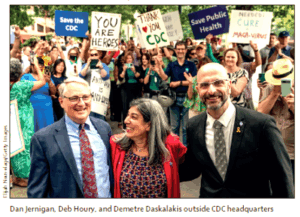
CDC is “in the ICU right now” former officials say
Volume 406, Issue 10508
13 September 2025
WORLD REPORT Senior officials say HHS Secretary Robert F Kennedy Jr is eviscerating the CDC. Washington Correspondent Susan Jaffe reports.
The US Centers for Disease Control and Prevention (CDC) implosion was months in the making, senior officials tell The Lancet after they resigned in protest following the dismissal of CDC Director Susan Monarez by Health and Human Services (HHS) Secretary Robert F Kennedy Jr. They describe a gutted agency so damaged that it might not be able to fulfil its core mission to protect Americans from public health threats. An HHS spokeswoman called their comments “the gripes of disgruntled former employees.” [Continued here.]
… AMA protests changes to key vaccine advisory committee
Volume 405, Issue 10496
21 June 2025
WORLD REPORT The organisation, which represents more than 270 000 physicians and medical students, has
been reluctant to criticise the Trump administration’s actions, until now. Susan Jaffe reports.
After months of relative quiet while the Trump administration overhauls US health and science agencies, the American Medical Association has had enough. When Health and Human Services Secretary Robert F Kennedy Jr dismissed all 17 members of the independent Advisory Committee on Immunization Practices, delegates attending AMA’s annual meeting strongly condemned the action. On June 10, more than 700 delegates approved an emergency resolution calling on Kennedy to reverse his decision [and] required AMA leadership to “immediately” ask the Senate committee overseeing HHS to investigate Kennedy’s actions “regarding his administration of the Centers for Disease Control and Prevention and Advisory Committee on Immunization Practices”. [Continued here.]
When Hospitals Ditch Medicare Advantage Plans, Thousands of Members Get To Leave, Too
By
 For several years, Fred Neary had been seeing five doctors at the Baylor Scott & White Health system, whose 52 hospitals serve central and northern Texas, including Neary’s home in Dallas. But in October, his Humana Medicare Advantage plan — an alternative to government-run Medicare — warned that Baylor and the insurer were fighting over a new contract. If they couldn’t reach an agreement, he’d have to find new doctors or new health insurance.
“All my medical information is with Baylor Scott & White,” said Neary, 87, who retired from a career in financial services. His doctors are a five-minute drive from his house. “After so many years, starting over with that many new doctor relationships didn’t feel like an option.”
After several anxious weeks, Neary learned Humana and Baylor were parting ways as of this year, and he was forced to choose between the two. Because the breakup happened during the annual fall enrollment period for Medicare Advantage, he was able to pick a new Advantage plan with coverage starting Jan. 1, a day after his Humana plan ended.
 Other Advantage members who lose providers are not as lucky. Although disputes between health systems and insurers happen all the time, members are usually locked into their plans for the year and restricted to a network of providers, even if that network shrinks. Unless members qualify for what’s called a special enrollment period, switching plans or returning to traditional Medicare is allowed only at year’s end, with new coverage starting in January.
But in the past 15 months, the Centers for Medicare & Medicaid Services, which oversees the Medicare Advantage program, has quietly offered roughly three-month special enrollment periods allowing thousands of Advantage members in at least 13 states to change plans. They were also allowed to leave Advantage plans entirely and choose traditional Medicare coverage without penalty, regardless of when they lost their providers. But even when CMS lets Advantage members leave a plan that lost a key provider, insurers can still enroll new members without telling them the network has shrunk.
…CMS would not identify plans whose members were allowed to disenroll after losing health providers. The agency also would not say whether the plans violated federal provider network rules intended to ensure that Medicare Advantage members have sufficient providers within certain distances and travel times. [Continued in KFF Health News, Fortune, MSN, Medpage Today, Boston Herald, Los Angeles Daily News, and Yahoo News.]
…
Trump works towards US tariffs on drug imports
Volume 405, Issue 10490
10 May 2025
WORLD REPORT Observers warn of the negative health consequences if US President Donald Trump follows through on his promise to impose tariffs on pharmaceuticals. Susan Jaffe reports.
Prescription drugs were excluded from US President Donald Trump’s tariffs that have rocked global markets and fuelled trade wars. But two recent actions signal the administration’s intention to eliminate that protection. Last month, Trump ordered the Department of Commerce to investigate whether the USA’s dependence on imported pharmaceuticals is a potential national security threat. If so, imposing tariffs would be a likely defence against imports. [Continued here.]…
Can the FDA fulfil its mission with a smaller workforce?
Volume 405, Issue 10488
26 April 2025
WORLD REPORT The US Food and Drug Administration’s new commissioner promises to restore public trust despite mass layoffs. Washington Correspondent Susan Jaffe reports.
Martin Makary fielded questions for nearly 2 h from a Senate committee last month before winning approval to take the helm as commissioner at the Food and Drug Administration (FDA). His early actions have provided some additional answers about how he will likely run an agency that impacts Americans’ daily lives but is depleted by the forced departure of at least 3500 scientists and other staff. [Continued here.]…
Robert Kennedy Jr’s Promises
Volume 405, Issue 10480
1 March 2025
WORLD REPORT To earn enough Senate votes for confirmation as Secretary of the US Department of Health and Human Services (HHS), Robert F Kennedy Jr made some surprising promises for someone aspiring to become the nation’s top health official. He had to reassure a few sceptical Republican senators that he would not overturn years of accepted public health policies, medical practice, and scientific consensus. And yet, in just the short time since assuming his new post on Feb 13, Kennedy’s actions—and inaction—appear to undermine those commitments as thousands of HHS employees are laid off under President Donald Trump’s executive orders shrinking the size and cost of government. [Continued here.]
…
Trump agenda ignites legal challenges
Volume 405, Issue 10477
8 February 2025
WORLD REPORT After just 3 weeks in the White House, US President Donald Trump’s executive orders have caused chaos and concern—and now, resistance. Susan Jaffe reports from Washington, DC.
“There’s nothing unusual about an executive order”, said Professor Emeritus Laurence Tribe, an expert in constitutional law at Harvard Law School. “What is unusual is for the President of the United States to say, ‘I can do anything I want, as long as I package it in an executive order. I can exercise not only the power to enforce the laws, which is basically what the executive branch does, but also the power to ignore law.’ ” Lawsuits have been filed to block executive orders affecting federal funding, workforce protections, closing the US Agency for International Development, and information on government websites including the Center for Disease Control and Prevention.[Full article here, includes links to updates on legal actions and executive orders.]
…
Can the US health-care workforce keep pace with demand?
Volume 404, Issue 10469
7 December 2024 
WORLD REPORT A physician and nurse shortage hinders access to care but efforts to educate, recruit, and retain more providers may be threatened. Susan Jaffe reports from Washington, DC.
The uninsured rate in the United States is at an historic low. But a shortage of health-care providers means even people who can afford to go to the doctor might not be able to find one.[Full story here, from The Lancet’s special issue, “A Presidential Briefing Book.”]…
Harris or Trump? Health in the US election
Volume 404, Issue 10464
2 November 2024
WORLD REPORT Aside from abortion, health issues have largely been neglected in the run-up to the Nov 5 election. What have the candidates proposed to improve health? Susan Jaffe reports.


As election day approaches on Nov 5, the US presidential race remains a tense and close competition despite unprecedented events—the Democratic candidate was replaced in August, and two attempts have been made to assassinate the Republican candidate. And despite the sharp contrast between former President Donald Trump, a Republican, and Democrat Vice President Kamala Harris, neither has so far managed to emerge as the frontrunner as The Lancet went to press. [Here‘s what the candidates say they would do on abortion, Affordable Care Act and other key health issues.]…
Medicare Drug Plans Are Getting Better Next Year. Some Will Also Cost More.
Improvements to Medicare drug coverage required by the IRA are the most sweeping changes since Congress added the benefit in 2003, but most voters don’t know about them. And some beneficiaries may be surprised by a downside: premium increases.
By
When Pam McClure learned she’d save nearly $4,000 on her prescription drugs next year, she said, “it sounded too good to be true.” She and her husband are both retired and live on a “very strict” budget in central North  Dakota.
By the end of this year, she will have spent almost $6,000 for her medications, including a drug to control her diabetes.
McClure, 70, is one of about 3.2 million people with Medicare prescription drug insurance whose out-of-pocket medication costs will be capped at $2,000 in 2025 thanks to the Biden administration’s 2022 Inflation Reduction Act….
“It’s wonderful — oh my gosh. We would actually be able to live,’’ McClure said. “I might be able to afford fresh fruit in the wintertime.” [Continued in KFF Health News, CBS NEWS, Los Angeles Times, and The Atlanta Journal-Constitution.]
…Why aren’t the Republicans talking about health?
Volume 403, Issue 10450
27 July 2024
WORLD REPORT Health-care issues were conspicuously absent from the 4-day party convention culminating in Donald Trump’s nomination as the Republican 2024 presidential candidate. Susan Jaffe reports.
Former US President Donald Trump spent 93 minutes accepting the Republican Party’s nomination for president last week, exceeding his own 2016 record for the longest acceptance speech at a political convention. But there was no time to mention major health-care issues such as abortion, the COVID-19 pandemic, medical research funding, the Affordable Care Act (ACA), or the opioid epidemic, to name a few. Yet domestic and global healthcare spending consume the largest part of the US budget. [Continued here.]…
Dr. Mandy Cohen’s first year as Director of the Centers for Disease Control and Prevention
23 July 2024
PROFILE Mandy Cohn: public health advocate and CDC director

“My North Star has been about building healthier communities”, Dr. Cohen said. “Sometimes that’s about access to doctors and hospitals and sometimes that’s about larger issues, and how we build healthier communities where we live, work, play, and pray.” That goal has motivated Cohen throughout her career. “I loved being a physician, but I’m always thinking about the broader context in which my patients live.” [Full article here.]
…
US Supreme Court protects access to abortion medication
Volume 403, Issue 10445
22 June 2024

WORLD REPORT Justices did not address claims that mifepristone endangered patients and that its approval by the FDA was flawed. Opponents vow to continue the legal fight. Susan Jaffe reports [continued here].
…
Biden Plan to Save Medicare Patients Money on Drugs Risks Empty Shelves, Pharmacists Say
-

From left, pharmacists Brent Talley of North Carolina, Scott Pace of Arkansas, and Clint Hopkins of California. (ELIZABETH TALLEY; KORI GORDON; JOEL HOCKMAN)
By Susan Jaffe | KFF Health News | June 11, 2024


10 years on: the legacy of the Flint water crisis
Volume 403, Issue 10437
27 April1 2024
WORLD REPORT The exposure of residents to lead in drinking water caused a national outcry, prompting requirements to update infrastructure and tighten water quality standards. Susan Jaffe reports.
“Flint is making an impact beyond Flint”, said Mona Hanna-Attisha, a Flint paediatrician who collected data on children’s lead blood levels in 2015. “We’re sharing those big lessons—the need to respect science, the need to invest in prevention, the need to pay attention to things like infrastructure and inequities, but also the really amazing lesson of doing something about it.”. [Continued here]…
Your Doctor or Your Insurer? Little-Known Rules May Ease the Choice in Medicare Advantage
By ,

Bart Klion (Hans Pennink for KFF Health News)
Bart Klion, 95, and his wife, Barbara, faced a tough choice in January: The upstate New York couple learned that this year they could keep either their private, Medicare Advantage insurance plan — or their doctors at Saratoga Hospital.
The Albany Medical Center system, which includes their hospital, is leaving the Klions’ Humana plan — or, depending on which side is talking, the other way around. The breakup threatened to cut the couple’s lifeline to cope with serious chronic health conditions.
Klion refused to pick the lesser of two bad options without a fight.
..With rare exceptions, Advantage members are locked into their plans for the rest of the year — while health providers may leave at any time. …But a few years ago, CMS created an escape hatch by expanding special enrollment periods, or SEPs, which allow for “exceptional circumstances.” Beneficiaries who qualify can request SEPs to change plans or return to original Medicare. [Continued on KFF Health News]…

Volume 403, Issue 10427 ♦ 17 February 2024
PROFILE Dr. Monica Bertagnolli, Director of the National Institutes of Health
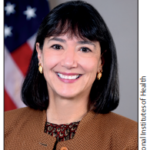
“I imagine a health-care system where clinical decisions are informed in real time by current research data,” the new National Institutes of Health director tells The Lancet. “And one where patients have the opportunity to both contribute their data for research and get back research results so that they can experience the best that science has to offer.” [Susan Jaffe reports here.]…
Imported drugs unlikely to lower US prices any time soon
Volume 403, Issue 10423
20 January 2024
WORLD REPORT Americans pay some of the highest prices in the world for prescription drugs, but the decision by the US Food and Drug Administration to allow Florida to import cheaper medications from Canada won’t cut prices any time soon. Although the ruling represents a shift in the decades-long fight for drug importation, opposition from the US pharmaceutical industry, Canadian health officials, and others is expected to block implementation at every stage. [Susan Jaffe reports, here]…
Dodging the Medicare Enrollment Deadline Can Be Costly
By , 
Angela M. Du Bois, a retired software tester in Durham, North Carolina, wasn’t looking to replace her UnitedHealthcare Medicare Advantage plan. She wasn’t concerned as the Dec. 7 deadline approached for choosing another of the privately run health insurance alternatives to original Medicare.
But then something caught her attention: When she went to her doctor last month, she learned that the doctor and the hospital where she works will not accept her insurance next year.
Faced with either finding a new doctor or finding a new plan, Du Bois said the decision was easy. “I’m sticking with her because she knows everything about me,” she said of her doctor, whom she’s been seeing for more than a decade.
Du Bois isn’t the only one tuning out when commercials about the open enrollment deadline flood the airwaves each year — even though there could be good reasons to shop around. But sifting through the offerings has become such an ordeal that few people want to repeat it. Avoidance is so rampant that only 10% of beneficiaries switched Medicare Advantage plans in 2019.
Once open enrollment ends, there are limited options for a do-over…. [Continued on Kaiser Health News and NPR]…
Uncle Sam Wants You … to Help Stop Insurers’ Bogus Medicare Advantage Sales Tactics
By ,

People gathered at the U.S. Capitol in Washington, D.C. in July protested denials and delays in private Medicare Advantage plans. (Alex Wong/Getty Image)
After an unprecedented crackdown on misleading advertising claims by insurers selling private Medicare Advantage and drug plans, the Biden administration hopes to unleash a special weapon to make sure companies follow the new rules: you.
Officials at the Centers for Medicare & Medicaid Services are encouraging seniors and other members of the public to become fraud detectives by reporting misleading or deceptive sales tactics to 800-MEDICARE, the agency’s 24-hour information hotline. Suspects include postcards designed to look like they’re from the government and TV ads with celebrities promising benefits and low fees that are available only to some people in certain counties.
The new rules, which took effect Sept. 30, close some loopholes in existing requirements by describing what insurers can say in ads and other promotional materials as well as during the enrollment process. [Continued on Kaiser Health News and NPR]…