Category: Medicaid
Millions to lose Medicaid coverage under new law
Volume 406, Issue 10500
19 July 2025
WORLD REPORT President Trump’s One Big Beautiful Bill Act makes the largest cuts to Medicaid since its creation, with doctors warning that patients will suffer. Susan Jaffe reports.

Republicans in the US Congress gave President Donald Trump his first major legislative victory, which provides the largest amount of tax and spending cuts in US history. The One Big Beautiful Bill Act (OBBB) slashes nearly $1 trillion over a decade from Medicaid—the most sweeping cuts since the health insurance programme for people with low incomes was created 60 years ago. The law will hit another historic first by taking health insurance away from more US residents than ever before—nearly 17 million, according to the Congressional Budget Office.
Robert Kennedy Jr’s Promises
Volume 405, Issue 10480
1 March 2025
WORLD REPORT To earn enough Senate votes for confirmation as Secretary of the US Department of Health and Human Services (HHS), Robert F Kennedy Jr made some surprising promises for someone aspiring to become the nation’s top health official. He had to reassure a few sceptical Republican senators that he would not overturn years of accepted public health policies, medical practice, and scientific consensus. And yet, in just the short time since assuming his new post on Feb 13, Kennedy’s actions—and inaction—appear to undermine those commitments as thousands of HHS employees are laid off under President Donald Trump’s executive orders shrinking the size and cost of government. [Continued here.]
…
Modest health goals for new US Congress
Volume 400, Issue 10369
17 December 2022
WORLD REPORT With Congress almost evenly split between Republicans and Democrats, consensus on any major health legislation is unlikely. Susan Jaffe reports.
When a new US Congress convenes in January, 2023, the slim Republican majority in the House of Representatives and the Democrats’ even smaller margin in the Senate will not enable either party to make major changes in the health-care system. With President Joe Biden promising to use his veto power to defend his health-care agenda, no significant fixes are expected. But there appears to be bipartisan support for some less ambitious legislation on issues that will overcome congressional gridlock.[Continued here.]…
Medicaid Weighs Attaching Strings to Nursing Home Payments to Improve Patient Care
3 States Limit Nursing Home Profits in Bid to Improve Care
“If they choose to rely on public dollars to deliver care, they take on a greater responsibility,” says New York Assemblyman Ron Kim. “It’s not like running a hotel.”
By Susan Jaffe | KAISER HEALTH NEWS | October 25, 2021 | This story also ran on
Nursing homes receive billions of taxpayers’ dollars every year to care for chronically ill frail elders, but until now, there was no guarantee that’s how the money would be spent.
Massachusetts, New Jersey and New York are taking unprecedented steps to ensure they get what they pay for,
after the devastating impact of covid-19 exposed problems with staffing and infection control in nursing homes. The states have set requirements for how much nursing homes
must spend on residents’ direct care and imposed limits on what they can spend elsewhere, including administrative expenses, executive salaries and advertising and even how much they can pocket as profit. …With this strategy, advocates believe, residents won’t be shortchanged on care, and violations of federal quality standards should decrease because money will be required to be spent on residents’ needs. At least that’s the theory. [Continued on Kaiser Health News, Fortune, NBC News, Yahoo Finance, and Chicago Sun-Times]…
The Push For Nursing Home Reform In The Middle Of A Pandemic
Sept. 20, 2021 | Today on NPR‘s news program “1A,” reporter Susan Jaffe discusses her Kaiser Health News story about new state laws protecting nursing home residents in response to the COVID-19 pandemic. Changes affect staffing, visitation rights, virtual communications, “essential support persons,” and more. A resident of a Connecticut nursing home quoted in this KHN article is also a guest. …
Chiquita Brooks-LaSure: innovative US federal health director
Volume 398, Issue 10300
14 August 2021
PROFILE 
Chiquita Brooks-LaSure, President Joe Biden’s choice to lead the Centers for Medicare and Medicaid Services, presides over an agency with a US$1 trillion budget that provides health insurance to more than 154 million people. Tackling health-care inequities is one of her top priorities. “These disparities have long existed, but COVID-19 has illuminated them in a way that is really unprecedented”, she said. [Full story here.]
…
Zooming Into the Statehouse: Nursing Home Residents Use New Digital Skills to Push for Changes
By Susan Jaffe | Kaiser Health News | June 9, 2021 | This KHN story also ran on
and
Patty Bausch isn’t a Medicaid expert, lawyer or medical professional. But she still thinks Connecticut legislators need her input when they consider bills affecting people like her — the roughly 18,000 residents who live in the state’s nursing homes.
With help and encouragement from Connecticut’s Long Term Care Ombudsman Program, Bausch signed up and testified remotely before a legislative hearing this year. Nursing home residents who have been using digital technology to reach out to family and friends — after the covid pandemic led officials to end visitation last year — could also use it to connect with elected officials once the legislature moved to remote hearings. Speaking into an iPad provided by the ombudsman’s office, Bausch testified without ever leaving her room at the Newtown Rehabilitation & Health Care Center, where she has lived since having a stroke three years ago. The combination of a virtual legislature and nursing home residents equipped with internet access has created an opportunity most nursing home residents rarely have — to participate in their government up close and in real time. [Continued on Kaiser Health News, Next Avenue and Connecticut Public Radio.]…
Biden’s first legislative victory: $1·9 trillion for COVID-19
Volume 397, Issue 10279
20 March 2021
WORLD REPORT US President Joe Biden’s first legislative triumph will fund the COVID-19 response and economic recovery, and address social determinants of health. Susan Jaffe reports from Washington, DC.
By narrowly approving a massive COVID-19 response and economic relief package last week, Democrats in Congress handed President Joe Biden his first legislative victory after only 50 days in the White House. The US$1·9 trillion, 628-page, American Rescue Plan Act is a signature achievement so monumental that it has been compared to President Lyndon B Johnson’s sweeping Great Society legislation that raised many Americans out of poverty, with a safety net of social and health services, including the Medicare and Medicaid insurance programmes.
…As the government begins to roll out these benefits, Biden promised “fastidious oversight to make sure there’s no waste or fraud, and the law does what it’s designed to do. And I mean it: we have to get this right… because we have to continue to build confidence in the American people that their government can function for them and deliver.” [Full story with “where the money goes” sidebar here.]
…
US Supreme Court poised to keep the Affordable Care Act
Volume 396, Issue 10263
21 November 2020
WORLD REPORT A lawsuit to overturn the Affordable Care Act may be floundering after Supreme Court justices questioned why the law should be dismantled. Susan Jaffe reports from Washington, DC.
The fate of the Affordable Care Act (ACA) is again in the hands of the US Supreme Court, after close calls in lawsuits in 2012 and 2015. But last week’s hearing was different: justices who once voted to overturn the law— along with President Donald Trump’s recent court appointees—bombarded opponents with sceptical questions.
After oral arguments in the case, known as California v. Texas, legal experts believe President Barack Obama’s signature health reform law is not in mortal danger. [Continued here.]
…US election 2020: the future of the Affordable Care Act
Volume 396, Number 10260 31 October 2020
WORLD REPORT President Donald Trump pledges to replace the Affordable Care Act while his Democratic opponent Joe Biden offers detailed proposals to improve it. Susan Jaffe reports from Washington, DC.
Since winning the presidency in 2016 in large part by promising to eliminate Obamacare, otherwise known as the Affordable Care Act (ACA), Donald Trump has promised more than a dozen times that his replacement plan would be ready soon. The plan would be released in 2 weeks, a White House spokeswoman said 2 months ago.

“We’re going to have a health-care plan that will be second to none”, Trump said in 2017. “It’s going to be great and the people will see that.” And at last week’s final presidential debate, he vowed “to terminate Obamacare, [and] come up with a brand new beautiful health care”.
A decade after the ACA—President Barack Obama’s signature achievement—became law, repealing and replacing Obamacare is again central to Trump’s re-election. And improving and expanding the law is a crucial part of the campaign of his challenger, former Vice President Joe Biden. [Continued here.]
…Pandemic Deals Another Blow To Nursing Homes: Plummeting Occupancy
BY SUSAN JAFFE | CONNECTICUT HEALTH INVESTIGATIVE TEAM | SEPTEMBER 16, 2020 
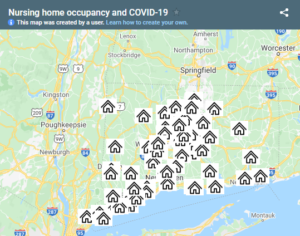
While the deadly coronavirus seems to be subsiding in Connecticut for now, its impact on nursing homes has not. More than 6,700 beds are empty, and it may take many months of financial struggle before occupancy climbs back to pre-pandemic levels.
Of the approximately 200 nursing homes in Connecticut that receive payments from Medicaid, the government health insurance program for low-income people, only 15 were
70% or less occupied in January, according to the Connecticut Health Investigative Team’s analysis of state data. By August, almost five times as many facilities saw occupancy drop to that level or less….
Owners say the state and federal governments aren’t doing enough to shore up their industry and protect residents during the pandemic. And in some cases, policies intended to control the virus can make things worse. [Continued here, with map and table of dangerously low occupancy nursing homes.]…
USA sets goal to end the HIV epidemic in a decade
Volume 393, Number 10172
16 February 2019
WORLD REPORT The unexpected announcement in the State of the Union address could set the start of a realistic agenda to end HIV/AIDS in the USA, provided funds are secured. Susan Jaffe reports.
Nearly an hour into his 90 min State of the Union address, President Donald Trump called for a government-run health-care programme “to eliminate the HIV epidemic in the United States within 10 years”.
Although the president has promised to get rid of the Affordable Care Act (ACA) along with its health insurance marketplaces and Medicaid expansion, these and other policies did not appear to dampen his enthusiasm. [Continued here.]…
NYC guarantees health care to all
Volume 393, Number 10169
26 January 2019
WORLD REPORT The mayor of New York City is not counting on Congress for solutions to its health-care problems, Susan Jaffe reports.
By encouraging patients to seek primary and preventive care instead of more expensive emergency care, city officials expect to save money and keep people healthy.
Medicare Advantage Plans Cleared To Go Beyond Medical Coverage — Even Groceries
By Susan Jaffe | Kaiser Health News | April 3, 2018 | This KHN story also ran on 
Air conditioners for people with asthma, healthy groceries, rides to medical appointments and home-delivered meals may be among the new benefits added to Medicare Advantage [private insurance] coverage when new federal rules take effect next year.

The Institute for Aging in San Francisco helps seniors get to doctor appointments and social activities. (Photo/Susan Jaffe)
…But patient advocates including David Lipschutz. senior policy attorney at the Center for Medicare Advocacy, are concerned about those who may be left behind. “It’s great for the people in Medicare Advantage plans, but what about the majority of the people who are in traditional Medicare?” he asked. “As we tip the scales more in favor of Medicare Advantage, it’s to the detriment of people in traditional Medicare.” [Continued at Kaiser Health News, The Philadelphia Inquirer, The Washington Post and CNN Money]
…Home Care Agencies Often Wrongly Deny Medicare Help To The Chronically Ill
By Susan Jaffe | Kaiser Health News | January 18, 2018 | This KHN story also ran on 

Colin Campbell (Heidi de Marco/KHN)
Colin Campbell needs help dressing, bathing and moving between his bed and his wheelchair. He has a feeding tube because his partially paralyzed tongue makes swallowing “almost impossible,”he said.
Campbell, 58, spends $4,000 a month on home health care services so he can continue to live in his home just outside Los Angeles. Eight years ago, he was diagnosed with amyotrophic lateral sclerosis, or “Lou Gehrig’s disease,” which relentlessly attacks the nerve cells in his brain and spinal cord and has no cure.
The former computer systems manager has Medicare coverage because of his disability, but no fewer than 14 home health care providers have told him he can’t use it to pay for their services. That’s an incorrect but common belief…. [Continued at Kaiser Health News and NPR]…
US Children’s Health Insurance Program in jeopardy
Volume 390, Number 10114
23/30 December 2017

WORLD REPORT Without adequate federal funding, CHIP is on the verge of collapse in several states. Susan Jaffe, The Lancet’s Washington correspondent, reports.
“Whoever would have thought that health care for children—that has support on both sides of the aisle—would be in this situation?” asked Deborah Oswalt, executive director of the Virginia Health Care Foundation. [full story here]
…
Counting On Medicaid To Avoid Life In A Nursing Home? That’s Now Up To Congress.
By Susan Jaffe | KAISER HEALTH NEWS | July 31, 2017 |This story also ran in 

Ten years ago, a driver ran a stop sign as Jim McIlroy rode into the intersection on his motorcycle. Serious injuries left McIlroy paralyzed from the chest down. But, after spending some time in a nursing home, he returned to his home near Bethel, Maine.
McIlroy does most of his own cooking since Maine’s Medicaid program paid for a stovetop that he can roll his wheelchair underneath to reach the food-prep area. His

Esther Ellis received a new mattress earlier this year from Partners in Care, a nonprofit that runs four of the dozens of sites in California’s Multipurpose Senior Services Program, a Medicaid-funded home services program. (Heidi de Marco/KHN)
new kitchen sink has the same feature. Wheelchair-friendly wood flooring has replaced McIlroy’s wall-to-wall carpeting.
The alterations plus a personal care aide — all paid for by Medicaid — enable McIlroy to stay in his house that he and his wife, who has since died, “worked really hard to own,” he said. The arrangement also saves Medicaid roughly two-thirds of what it would cost if he lived in a nursing home.
McIlroy depends on the federal-state program’s growing support of home-based care services — along with 2 million elderly or disabled Americans who rely on them to live at home for as long as possible.
However, that crucial help could face severe cuts if congressional Republicans eventually succeed in their push to sharply reduce federal Medicaid funds to states. [Continued at Kaiser Health News and USA Today]
…