Volume 407, Issue 10543
23 May 2026
WORLD REPORT Experts question the effectiveness of the Trump administration’s strategies to cut pharmaceutical costs in the USA. Washington Correspondent Susan Jaffe reports.
…
…

Republicans in the US Congress gave President Donald Trump his first major legislative victory, which provides the largest amount of tax and spending cuts in US history. The One Big Beautiful Bill Act (OBBB) slashes nearly $1 trillion over a decade from Medicaid—the most sweeping cuts since the health insurance programme for people with low incomes was created 60 years ago. The law will hit another historic first by taking health insurance away from more US residents than ever before—nearly 17 million, according to the Congressional Budget Office.
…

The uninsured rate in the United States is at an historic low. But a shortage of health-care providers means even people who can afford to go to the doctor might not be able to find one.[Full story here, from The Lancet’s special issue, “A Presidential Briefing Book.”]…


As election day approaches on Nov 5, the US presidential race remains a tense and close competition despite unprecedented events—the Democratic candidate was replaced in August, and two attempts have been made to assassinate the Republican candidate. And despite the sharp contrast between former President Donald Trump, a Republican, and Democrat Vice President Kamala Harris, neither has so far managed to emerge as the frontrunner as The Lancet went to press. [Here‘s what the candidates say they would do on abortion, Affordable Care Act and other key health issues.]…
Volume 400, Issue 10369
WORLD REPORT With Congress almost evenly split between Republicans and Democrats, consensus on any major health legislation is unlikely. Susan Jaffe reports.
When a new US Congress convenes in January, 2023, the slim Republican majority in the House of Representatives and the Democrats’ even smaller margin in the Senate will not enable either party to make major changes in the health-care system. With President Joe Biden promising to use his veto power to defend his health-care agenda, no significant fixes are expected. But there appears to be bipartisan support for some less ambitious legislation on issues that will overcome congressional gridlock.[Continued here.]…
Nursing homes receive billions of taxpayers’ dollars every year to care for chronically ill frail elders, but until now, there was no guarantee that’s how the money would be spent.
Massachusetts, New Jersey and New York are taking unprecedented steps to ensure they get what they pay for,
after the devastating impact of covid-19 exposed problems with staffing and infection control in nursing homes. The states have set requirements for how much nursing homes

must spend on residents’ direct care and imposed limits on what they can spend elsewhere, including administrative expenses, executive salaries and advertising and even how much they can pocket as profit. …With this strategy, advocates believe, residents won’t be shortchanged on care, and violations of federal quality standards should decrease because money will be required to be spent on residents’ needs. At least that’s the theory. [Continued on Kaiser Health News, Fortune, NBC News, Yahoo Finance, and Chicago Sun-Times]…

Sept. 20, 2021 | Today on NPR‘s news program “1A,” reporter Susan Jaffe discusses her Kaiser Health News story about new state laws protecting nursing home residents in response to the COVID-19 pandemic. Changes affect staffing, visitation rights, virtual communications, “essential support persons,” and more. A resident of a Connecticut nursing home quoted in this KHN article is also a guest. …
So far, 23 states have passed more than 70 new pandemic-related provisions affecting nursing home operations.
By Susan Jaffe | KAISER HEALTH NEWS | August 17, 2021 | This story also ran in![]()
When the coronavirus hit Martha Leland’s Connecticut nursing home last year, she and dozens of other residents contracted the disease while the facility was on lockdown. Twenty-eight residents died, including her roommate.
“The impact of not having friends and family come in and see us for a year was totally devastating,” she said. “And then, the staff all bound up with the masks and the shields on, that too was very difficult to accept.” She summed up the experience in one word: “scary.”
But under a law Connecticut enacted in June, nursing home residents will be able to designate an “essential support person” who can help

take care of a loved one even during a public health emergency. Connecticut legislators also approved laws this year giving nursing home residents free internet access and digital devices for virtual visits and allowing video cameras in their rooms so family or friends can monitor their care.
Similar benefits are not required by the Centers for Medicare & Medicaid Services, the federal agency that oversees nursing homes and pays for most of the care they provide. But states can impose additional requirements when those federal rules are insufficient or don’t exist. And that’s exactly what many are doing, spurred by the virus that hit the frail elderly hardest. [Continued at Kaiser Health News and USA Today]
…
Volume 398, Issue 10300

…
Volume 398, Issue 10294
…
By Susan Jaffe | Kaiser Health News | June 9, 2021 | This KHN story also ran on
and
Patty Bausch isn’t a Medicaid expert, lawyer or medical professional. But she still thinks Connecticut legislators need her input when they consider bills affecting people like her — the roughly 18,000 residents who live in the state’s nursing homes.
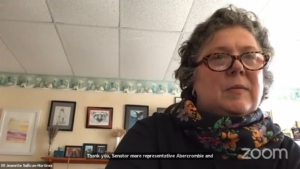
With help and encouragement from Connecticut’s Long Term Care Ombudsman Program, Bausch signed up and testified remotely before a legislative hearing this year. Nursing home residents who have been using digital technology to reach out to family and friends — after the covid pandemic led officials to end visitation last year — could also use it to connect with elected officials once the legislature moved to remote hearings. Speaking into an iPad provided by the ombudsman’s office, Bausch testified without ever leaving her room at the Newtown Rehabilitation & Health Care Center, where she has lived since having a stroke three years ago. The combination of a virtual legislature and nursing home residents equipped with internet access has created an opportunity most nursing home residents rarely have — to participate in their government up close and in real time. [Continued on Kaiser Health News, Next Avenue and Connecticut Public Radio.]…

By narrowly approving a massive COVID-19 response and economic relief package last week, Democrats in Congress handed President Joe Biden his first legislative victory after only 50 days in the White House. The US$1·9 trillion, 628-page, American Rescue Plan Act is a signature achievement so monumental that it has been compared to President Lyndon B Johnson’s sweeping Great Society legislation that raised many Americans out of poverty, with a safety net of social and health services, including the Medicare and Medicaid insurance programmes.
…As the government begins to roll out these benefits, Biden promised “fastidious oversight to make sure there’s no waste or fraud, and the law does what it’s designed to do. And I mean it: we have to get this right… because we have to continue to build confidence in the American people that their government can function for them and deliver.” [Full story with “where the money goes” sidebar here.]
…
COVID-19 has rampaged through nursing homes and other long-term-care facilities, leaving a death toll near 180,000 and counting. So when the first coronavirus vaccines became available at the end of last year, nursing home residents and staff were first in line, given top priority along with emergency responders and health care providers.
![]()
The federal government paid CVS and Walgreens to offer three vaccination clinics for residents and staff at nearly every nursing home in the U.S. That effort, called the Pharmacy Partnership for Long-Term Care Program, wraps up this month. So how do new nursing home residents and workers who missed the onsite clinics get vaccinated now? For residents, plans are in the works to make sure they get the shots. But so far, many of those plans don’t include the staff members who care for them. [Continued here.]…
By Susan Jaffe | Contributing Writer | MedPageToday | November 25, 2020

More than 91,000 residents and staff of long-term care facilities have died after contracting COVID-19 — about 40% of the total deaths in the U.S., according to a Kaiser Family Foundation analysis. …Frustrated by repeated violations of infection control requirements during the pandemic, CMS raised the penalty amounts and announced a crackdown on egregious offenders in August. But the hard-line approach doesn’t seem to have produced the intended results. (Click here for a list of nursing homes that were fined.) [Continued here.]

Volume 396, Number 10260 31 October 2020

While the deadly coronavirus seems to be subsiding in Connecticut for now, its impact on nursing homes has not. More than 6,700 beds are empty, and it may take many months of financial struggle before occupancy climbs back to pre-pandemic levels.
Of the approximately 200 nursing homes in Connecticut that receive payments from Medicaid, the government health insurance program for low-income people, only 15 were
70% or less occupied in January, according to the Connecticut Health Investigative Team’s analysis of state data. By August, almost five times as many facilities saw occupancy drop to that level or less….
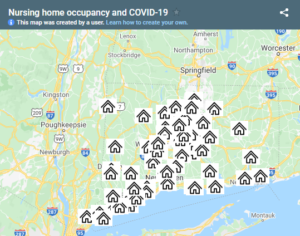
Owners say the state and federal governments aren’t doing enough to shore up their industry and protect residents during the pandemic. And in some cases, policies intended to control the virus can make things worse. [Continued here, with map and table of dangerously low occupancy nursing homes.]…
Medicare chief says “significant deficiencies in infection control practices” in nursing homes have doubled weekly COVID-19 cases, but “this isn’t a time of fines and being punitive.”


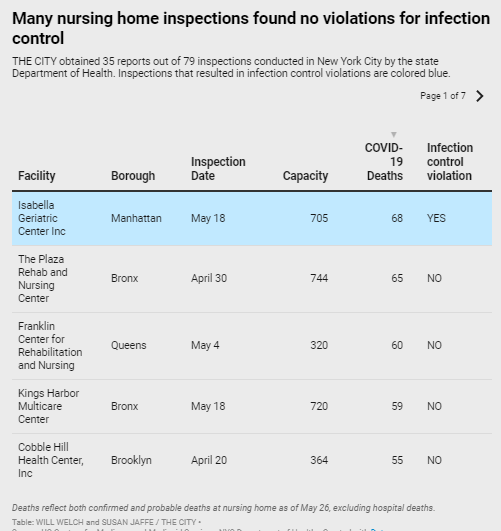
More than 600 residents have died from COVID-19 at 25 New York City nursing homes that received clean bills of health for controlling the spread of infections, state Department of Health inspection reports obtained by THE CITY show.
Those facilities inclu
de homes with some of the highest coronavirus death tolls in the nation — including the Sapphire Center for Rehabilitation and Nursing in Flushing, which reports 54 residents died of confirmed or presumed COVID….
At the Franklin Center for Rehabilitation and Nursing, also in Flushing, 60 residents — nearly one in five — succumbed to the virus. Its May 4 inspection report found no problems.
Also passing its May 11 infection-control inspection was New York State Veterans Home in St. Albans, Queens. Staff there previously told THE CITY that the state Health Department-run home failed to separate COVID-positive and uninfected residents, something that was a violation at other facilities….
“It’s very shocking that at the apex of this pandemic, our inspectors went in and reported that that there’s nothing out of the ordinary when it’s clear that the infection rate had spread,” said Assemblymember Ron Kim (D-Queens), whose district includes Sapphire and the Franklin Center. [continued here].
…