Tag: CDC
US plan to shield science from “inappropriate influence”
Volume 401, Issue 10375
11 February 2023
WORLD REPORT The Biden administration is launching a new initiative on scientific integrity in federal agencies following multiple lapses. Susan Jaffe reports from Washington, DC.
Just a week after Joe Biden was sworn in as president in January, 2021, he created a multi-agency Task Force on Scientific Integrity to restore “trust in government through scientific integrity and evidence-based policy making”…Last month, the White House Office of Science and Technology Policy released A Framework for Federal Scientific Integrity and Practice, a follow-up to the task force’s 2022 recommendations that provides a blueprint for implementation. [Continued here.] …
US CDC begins agency-wide changes after pandemic failures
Volume 400, Issue 10365
19 November 2022
WORLD REPORT An independent review made several recommendations for improving the public health agency. Susan Jaffe reports from Washington, DC.
Rochelle Walensky: New Director of the US CDC
Volume 397, Issue 10271
14 January 2021
PROFILE Rochelle Walensky
A highly respected researcher, Walensky has published nearly 300 papers, many focused on the cost-effectiveness of HIV interventions and aimed at improving patients’ care. “I call the research that I do policy motivating”, Walensky says. One example is a 2006 landmark study showed that advances in HIV treatment in the USA added nearly 3 million years to patients’ lives.[Full story here.]…
No barrier to CDC research on gun violence—except funding
Susan Jaffe | Washington Correspondent for The Lancet | 28th March 2018

A day after the horrific mass shooting at Marjory Stoneman Douglas High School in Parkland, Florida on February 14, where 17 students and faculty were murdered and 14 injured, Health and Human Services Secretary Alex Azar fielded budget questions from a congressional committee. In response to Representative Kathy Castor, a Democrat from Tampa, Florida, Azar said there is no restriction on the ability of the Centers for Disease Control and Prevention (CDC) to conduct research into the causes of gun violence.
Questions about CDC’s ability to investigate gun violence—as it

“March for Our Lives” rally in Washington, D. C. March 24, 2018. (Photo/Susan Jaffe)
would other public health threats—have persisted ever since Congress passed the 1996 Dickey Amendment prohibiting the use of research funds to advocate or promote gun control.
“We don’t believe that it gets in the way of our ability to do violence research or firearms violence research at any part of HHS,” Azar told another congressional panel a month later. “I think we’ve now made it quite publicly—and within the administration—clear that we don’t see any barriers around violence or firearm violence research. We’re in the evidence and science-gathering business.”
His assurances were also included in the instructions that accompanied the budget agreement Congress approved and President Donald Trump signed into law last week. While some observers believe this means CDC has permission from Congress to proceed, some leading experts in firearms research are skeptical. There may be no barriers, but they say there’s no funding either.[Continued here] …
After a weekend of negotiations and demonstrations, shutdown disrupts health agencies
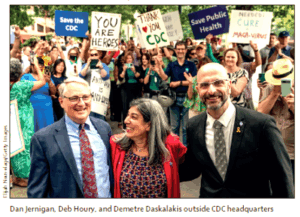
Susan Jaffe | Washington Correspondent for The Lancet | 22nd January 2018
On the first anniversary of Donald Trump’s inauguration as the 45th
president of the United States on January 20, 2018, the federal government ground to a shutdown and hundreds of thousands of women and their supporters rallied against the new president in dozens of cities across the country. [Continued here.]

…
US presidential candidates far apart on environmental health
Volume 388, Number 10043
30 July 2016
WORLD REPORT The Republican and Democratic campaigns have polar opposite policies on environmental issues
important to health. Susan Jaffe, The Lancet’s Washington correspondent, reports. [Continued here] …
US responds to increase in Zika cases
Volume 387, Number 10030
30 April 2016
WORLD REPORT Health officials pursue Zika research and prepare to combat a formidable foe—the mosquito— despite uncertain funding. Susan Jaffe, The Lancet’s Washington correspondent, reports.

Anthony Fauci
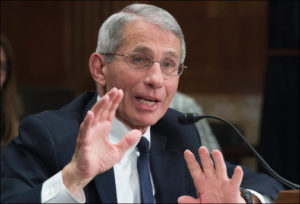
As the number of confirmed cases of people who have contracted the Zika virus increases across the globe, the growing knowledge about this once rare infection is not reassuring. “The more we learn, the more we get concerned”, said Anthony Fauci, director of the National Institute of Allergy and Infectious Diseases….
Representative Tom Cole, the Oklahoma Republican who is chairman of the House appropriations health subcommittee, said its questions about [President Barack Obama’s $1.9 billion Zika emergency funding] request are not unreasonable….“Let us do our job to make sure we do this as prudently as possible and we will get there”, he said. “Nobody thinks this is not a serious challenge”….
While clinical research and the funding debate continues, protection from the Zika virus will depend largely on avoiding the mosquitoes that carry it….
After years of cuts in federal and local funding for mosquito control, Zika is “a pretty major wake up call to rebuild those capacities”, said Lyle Petersen, director of CDC’s division of vector-borne infectious diseases. The virus is the latest “major pathogen that has come into the Americas” in recent years—after chikungunya, dengue fever, and West Nile virus—“and it won’t be the last.” [continued here] [listen to podcast here] …
NIH hopes funding increases will continue
Volume 387, Number 10019
13 February 2016
WORLD REPORT The US National Institutes of Health welcomed a record budget boost that might be the start of more sustained support. The Lancet’s Washington correspondent, Susan Jaffe, reports.
The US Congress recently approved the largest single increase in funding for the National Institutes of Health (NIH) in 12 years—a US$2 billion raise that was twice as much as President Barack Obama requested. But almost as soon as NIH supporters stopped cheering, they began to worry about next year’s budget, and the challenge of a new public health threat, Zika virus.
NIH Director Francis Collins told The Lancet that the funding boost “was enormously gratifying”. But if it is “a one-hit wonder”, he said “it won’t be sufficient to take full advantage of the remarkable scientific opportunities and talent that is out there”. [Continued here] [podcast here]
…
Congress Wrangles Over Funding for Zika Research
Susan Jaffe | Washington Correspondent for The Lancet | 12th February 2016
President Barack Obama asked Congress this week for more than $1.8 billion in emergency funding
to respond to Zika virus and administration officials wasted no time in explaining why at four congressional hearings less than two days later.
While such Capitol Hill visits are part of the budget process, the looming virus adds a new urgency to the proceedings–though not necessarily enough to deter controversy. [Continued here]…