Tag: Senator Ron Wyden
Califf takes the helm at the US FDA, again
Volume 399, Issue 10330
19 March 2022
WORLD REPORT Robert Califf will have to face several controversial health issues in his second tenure as commissioner. Susan Jaffe reports from Washington, DC.
election results could shrink, if not eliminate, the Democratic majority President Joe Biden needs to propel his health agenda, including the relaunched cancer moonshot and the Advanced Research Projects Agency for Health that would accelerate the development of medical treatments. [Plus new COVID-19 tests and treatments, opioid misuse, accelerated approval process, abortion pill conflict, continued here.]
US lawmakers seek cuts in prescription drug prices
Volume 393, Number 10175
9 March 2019
WORLD REPORT A committee brought together Senators and drug company representatives to discuss why drug pricing in the USA is so high, but little progress was made, Susan Jaffe reports.
A much-publicized Trump Administration proposal allows — not requires — pharmaceutical companies to pass large rebates on to Medicare patients. Savings as much as 30 percent for seniors depend on companies’ voluntarily cutting prices but several top drug makers tell Senate committee they can’t promise to do so. [Continued here.]
…State exemptions to the Affordable Care Act expanded
Volume 392, Number 10164
15 December 2018
WORLD REPORT In its latest blow to the ACA, the Trump administration provides guidance on how states can circumvent the health law. Susan Jaffe, The Lancet‘s Washington correspondent, reports.
Medicare’s Efforts To Curb Backlog Of Appeals Not Sufficient, GAO Reports
By Susan Jaffe | Kaiser Health News | June 10, 2016
Despite interventions by Medicare officials, the number of appeals from health care providers and patients
challenging denied claims continues to spiral, increasing the backlog of cases and delaying many decisions well beyond the timeframes set by law, according to a government study released Thursday.
The report from the Government Accountability Office, said the backlog “shows no signs of abating.” It called for the Department of Health and Human Services to improve its oversight of the process and to streamline appeals so that prior decisions are taken into account and repetitive claims are handled more efficiently.
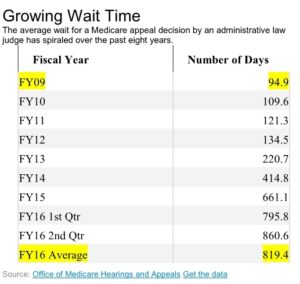
HHS officials have acknowledged the problem. Although a judge is required to issue a decision within 90 days, the average time from hearing request to decision is slightly more than two years, Nancy Griswold, the chief administrative law judge of the Office of Medicare Hearings and Appeals, said in an interview.
Requests for hearings increased “so dramatically and so quickly over the past four or five years — during a period of time when our adjudication capacity was not able to keep up for funding reasons — we were drowning” in appeals, she said. “It is not quite as bad right now, but we are unable to keep up with [those] that are coming in the door.” [Continued]…