Author: Jaffe.KHN@gmail.com
Whether By Luck Or Safety Protocols, Some Nursing Homes Remain COVID-19 Free
BY SUSAN JAFFE | CONNECTICUT HEALTH INVESTIGATIVE TEAM | JUNE 15,2020 
The coronavirus has decimated many of the nation’s nursing homes, and elderly, chronically ill residents of these facilities account for 64% of the state’s 4,201 death toll. They are roughly 100 times more likely to die of the virus than other people in the state.
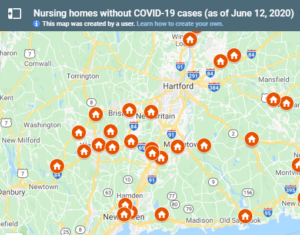
So, the fact that some 41 of Connecticut’s 214 nursing homes have managed to keep out the virus, according to an analysis by C-HIT, is both remarkable and mystifying. Did they just get lucky?

This article also ran on Connecticut Public Radio.
Administrators at several COVID-19-free facilities use the word “fortunate” to describe a situation they acknowledge could change at any time. [Continued here, with map and table of COVID-19 free nursing homes.]
…Hundreds Died of COVID at NYC Nursing Homes With Spotless Infection Inspections
By Susan Jaffe | THE CITY | May 27, 2020 
More than 600 residents have died from COVID-19 at 25 New York City nursing homes that received clean bills of health for controlling the spread of infections, state Department of Health inspection reports obtained by THE CITY show.
Those facilities inclu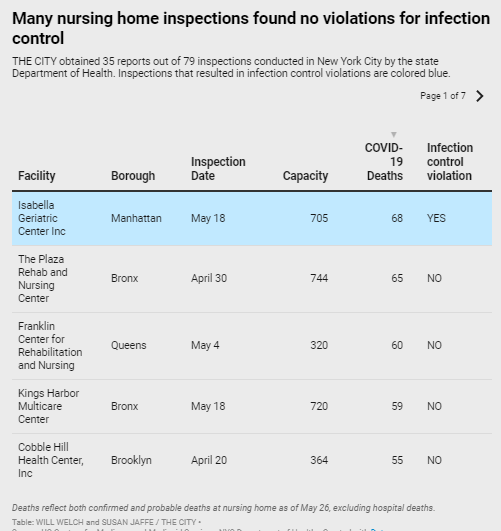 de homes with some of the highest coronavirus death tolls in the nation — including the Sapphire Center for Rehabilitation and Nursing in Flushing, which reports 54 residents died of confirmed or presumed COVID….
At the Franklin Center for Rehabilitation and Nursing, also in Flushing, 60 residents — nearly one in five — succumbed to the virus. Its May 4 inspection report found no problems.
Also passing its May 11 infection-control inspection was New York State Veterans Home in St. Albans, Queens. Staff there previously told THE CITY that the state Health Department-run home failed to separate COVID-positive and uninfected residents, something that was a violation at other facilities….
“It’s very shocking that at the apex of this pandemic, our inspectors went in and reported that that there’s nothing out of the ordinary when it’s clear that the infection rate had spread,” said Assemblymember Ron Kim (D-Queens), whose district includes Sapphire and the Franklin Center. [continued here].
…As Congress Weighs COVID Liability Protections, States Shield Health Providers
By Susan Jaffe | Kaiser Health News | May 14, 2020 | This story also ran on 
Coronavirus patients and their families who believe a doctor, nurse, hospital or other provider made serious mistakes during their care may face a new hurdle if they try to file medical malpractice lawsuits.

Under pressure from health provider organizations, governors in Connecticut, Maryland, Illinois and several other states have ordered that most providers be shielded from civil ― and, in some cases, criminal— lawsuits over medical treatment during the C OVID-19 health emergency. In New York and New Jersey, immunity is now part of state law….
Some legal experts and seniors’ advocates worry that the state immunity guarantees go too far, leaving patients with no way to hold providers accountable. Supporters argue that health care providers and facilities deserve protection from lawsuits as they battle a deadly virus during an unprecedented public health emergency. [Continued at Kaiser Health News and Daily Beast. ]
…Nursing Home Watchdogs Scarce At NYC Facilities As Hundreds Die Within
CLOSED DOORS | THE CITY | April 23, 2020
By
Eyes and ears usually trained on New York’s nursing homes and adult care facilities have been nearly locked out as the coronavirus has claimed the lives of more than 3,500 residents statewide.

Almost entirely out of the picture are nursing home inspectors,employed by the state Department of Health and
coordinated by the federal government, who are responsible for ensuring that the facilities comply with federal health and safety requirements.
“Nursing facilities are essentially free of public scrutiny right now, at a time when scrutiny is more important than ever,” said Susan Dooha, executive director of the Center for Independence of the Disabled in New York [continued here].
…Federal Regulators split on antimalarials for COVID-19
 Volume 395 Number 10231
11 April 2020
WORLD REPORT US and French authorities have authorised the use of chloroquine and hydroxychloroquine, but the EU regulator and WHO say the science doesn’t support the decision. Susan Jaffe reports.
With no “adequate, approved and available” alternative, the US Food and Drug Administration (FDA) is allowing the use of the antimalarial drugs hydroxychloroquine and chloroquine to treat coronavirus disease 2019 (COVID-19).
The FDA’s emergency use authorisation (EUA) issued last week gives physicians the option to prescribe the drugs, which President Donald Trump has recommended. However, both drugs are unproven and untested for COVID-19, and have rare but potentially deadly side-effects. The decision bypassed the usual drug approval process including doubleblind, placebo-controlled clinical trials, stoking a worldwide debate about whether the drugs are appropriate for treating the disease.
“I think it was resorted to more out of a sense of desperation”, said Joseph Masci, an infectious disease specialist and director of global health at Elmhurst Hospital in Queens, a borough of New York City, which is at the centre of the epidemic in the USA. “It is just an indication of how sudden and massive this outbreak has been.” [Continued here.]
…Federal Judge Rules Medicare Patients Can Challenge ‘Observation Care’ Status
By Susan Jaffe | Kaiser Health News | March 30, 2020| This story also appeared in 
Hundreds of thousands of Medicare beneficiaries who have been denied coverage for nursing home stays because their time in the hospital was changed from “inpati ent” to “observation care” can now appeal to Medicare for reimbursement, a federal judge in Hartford, Connecticut, ruled last week.
If the government does not challenge the decision and patients win their appeals, Medicare could pay them millions of dollars for staggeringly high nursing home bills….
“If I had gone home, I would have died,” said Ervin Kanefsky, 94, a plaintiff [in a class action lawsuit against Medicare] from suburban Philadelphia. He was admitted to the hospital as an inpatient after fracturing his shoulder in a fall. When he was about to leave after five days to recuperate at a nursing home, a hospital official told him his status had changed to observation. With one arm in a sling, stitches in the other and unable to hold onto his walker, he learned Medicare wouldn’t pay for the nursing home. [Continued at Kaiser Health News or The Philadelphia Inquirer.]
…State Says Hospitals Must Allow Support Person at Births
FAMILIES | THE CITY | March 28, 2020
The state Department of Health has toughened up its message to hospitals that have been telling pregnant women they can’t bring a partner or other support person into the delivery room because of coronavirus concerns. The new visitation policy’s boldface wording, issued late Friday, appears to leave little open to interpretation.
It “requires hospitals to allow one support person in labor and delivery settings if the patient so desires and two designated support persons in pediatric settings, provided that only one is present at a time.”
…The update reverses visitor bans announced earlier this week by New York-Presbyterian and Mount Sinai Health System in response to the coronavirus crisis. Other hospital systems had been expected to adopt similar procedures. [continued here]
…Leadership changes at USAID
 Volume 395 Number 102295 28 March 2020
WORLD REPORT Mark Green, the respected head of the US Agency for International Development, has resigned. Susan Jaffe reports from Washington.
“The timing is unfortunate”, said Jen Kates, senior vice president and director for global health and HIV policy at the Kaiser Family Foundation. “The agency is going to be significantlychallenged by the COVID-19 pandemic, potentially at a level that it has not seen before.” [continued here]
…Coronavirus Stresses Nursing Home Infection-Control Practices
I-TEAM IN-DEPTH | CONNECTICUT HEALTH INVESTIGATIVE TEAM | MARCH 12,2020

As coronavirus cases increase, posing heightened risks to the elderly, nursing homes will face growing scrutiny from state health inspectors.
In Connecticut and nationally, complying with federal infection-control requirements is a challenge for some nursing homes. Between 2017 and 2019, 145 of Connecticut’s 217 nursing homes – or about 67 percent – were cited for infection-control violations, according to a Conn. Health I-Team analysis of data from the Centers for Medicare & Medicaid Services (CMS). [Continued here, with list of nursing home infection violations.]
…
Medicare for All scrutinised in Democratic primaries

Volume 395 Number 10225 29 February 2020
WORLD REPORT On March 3, 14 states will pick their nominees for the US presidential election. The feasability of a single payer insurance plan is a key issue. Susan Jaffe reports from Washington, DC.
Anxiety about rising health-care costs— the top issue for Democratic voters, according to recent polls—propelled Bernie Sanders to the head of the pack in last week’s Democratic primary contest in Nevada. Of the six leading candidates vying for the party’s presidential nomination, Sanders, a Vermont senator and self-described democratic socialist, has proposed the most radical solution for lowering medical bills and reaching universal coverage. His signature policy initiative, the Medicare for All single-payer programme, would eliminate private health insurance, including employment-based plans that cover about half of the US population. [Article compares Medicare for All and the public option proposal favoured by former Vice President Joe Biden; continued here]
Decisions to be made on US gun violence research funds
 Volume 395 Number 10222 8 February 2020
WORLD REPORT The National Institutes of Health and the Centers for Disease Control and Prevention will decide how to spend new federal funds later this year. Susan Jaffe reports from Washington, DC.
After a hiatus of more than two decades, Congress and President Donald Trump agreed to add funding for gun violence research to the federal budget in December. With grants expected to be awarded in September, the priorities for research and its potential impact are crucial for halting the US’s record-breaking gun-related death toll. [Continued here.]
…Congress Considers Bill to Address Medicare Late Penalties, Coverage Gap
Current enrollment rules can leave late enrollees liable for doc visits Medicare usually covers
By Susan Jaffe | Contributing Writer | MedPageToday | January 20, 2020
Some 10,000 Americans turn 65 every day and become eligible for Medicare, but enrollment mistakes can subject them to a lifetime of late penalties, as well as a months-long coverage gap.

Legislation that would fix these problems was one of the bills discussed at a hearing held by the House Energy & Commerce Health Subcommittee…. Although the panel focused on how the bipartisan Beneficiary Enrollment Notification and Eligibility Simplification (BENES) Act impacts Medicare patients, it also affects their physicians. [Continued here and PDF here]
Website Errors Raise Calls For Medicare To Be Flexible With Seniors’ Enrollment
Seniors will be able to change plans any time next year if they discover their coverage doesn’t provide what the government’s Plan Finder promised.
By Susan Jaffe | Kaiser Health News | December 6, 2019 | This article also ran on 
Saturday is the deadline for most people with Medicare coverage to sign up for private drug and medical plans for next year. But members of Congress, heal th care advocates and insurance agents worry that enrollment decisions based on bad information from the government’s revamped, error-prone Plan Finder website will bring unwelcome surprises.
Beneficiaries could be stuck in plans that cost too much and don’t meet their medical needs — with no way out until 2021.
On Wednesday, the Centers for Medicare & Medicaid Services told Kaiser Health News that beneficiaries would be able to change plans next year because of Plan Finder misinformation, although officials provided few details. [Continued at Kaiser Health News or NPR.] …
Will Trump snuff out e-cigarettes?
Volume 394 Number 10213 30 November 2019
WORLD REPORT President Trump promised to ban flavoured e-cigarettes, but 11 weeks later, they are still on the shelves. Susan Jaffe reports from Washington.
When US President Donald Trump announced a plan on Sept 11 to prohibit the sale of most flavoured electronic cigarettes, more than 450 people in the USA had a mysterious lung disease associated with vaping, and six had died, according to the Centers for Disease Control and Prevention (CDC). The ban would be finalised within 30 days, said Health and Human Services Secretary Alex Azar.
The number of cases of the lung disease has since soared to 2290, as of Nov 20, in 49 states, Washington, DC, and the US Virgin Islands. 47 e-cigarette smokers (vapers) have died, according to the CDC. However, as this report went to press, officials from the Trump administration would not disclose when the promised ban would be issued.
…The decision [to implement] a nationwide ban is up to President Trump. “It is a chain of command”, said Robert Califf, a professor of cardiology at Duke University School of Medicine and the FDA commissioner under Trump and former President Barack Obama. “The commissioner reports to the Secretary of Health and Human Services [HHS]and the secretary reports to the president. FDA policies are de facto policies of the Executive Branch, so if the HHS secretary or president chooses to do so, they can intercede.” [Continued here]
…Cycling safety concerns grow in US cities
Volume 394 Number 10211 16 November 2019
WORLD REPORT As more bicycle riding is encouraged for health and environmental reasons, an increase in cycling deaths is causing a public health dilemma in the USA. Susan Jaffe reports.

Photo by Susan Jaffe Copyright © 2019
A record number of cycling deaths in the USA is attracting scrutiny from the US Congress, city officials, and the National Transportation Safety Board (NTSB), the government agency better known for investigating aeroplane crashes and other transportation disasters. …Last year, 859 cyclists were killed in road traffic crashes, the highest number in the USA since 1990, and a 6·3% increase since 2017, according to research from the US Department of Transportation’s National Highway Traffic Safety Administration published last month.
…In a preliminary report issued last week, the NTSB recommended that public officials take several steps to reduce the number of cycling deaths. The last time it examined bicycle safety was 47 years ago. [Continued here]
…As Medicare Enrollment Nears, Popular Price Comparison Tool Is Missing
By Susan Jaffe | Kaiser Health News | October 8, 2019 | This article also ran in the
Millions of older adults can start signing up next week for private policies offering Medicare drug and medical coverage for 2020. But many risk wasting money and even jeopardizing their health ca re due to changes in Medicare’s plan finder, its most popular website.
For more than a decade, beneficiaries used the plan finder to compare dozens of Medicare policies offered by competing insurance companies and get a list of their options. Yet after a website redesign six weeks ago, the search results are missing crucial details: How much will you pay out-of-pocket? And which plan offers the best value? [Continued at Kaiser Health News, San Francisco
Congress and President Trump take on high drug prices
 Volume 394 Number 10204 28 September 2019
WORLD REPORT Proposals from the White House and Congress to lower prescription drug costs, which both rejected more than a decade ago, are making a comeback. Susan Jaffe reports.
The Trump administration’s Department of Health and Human Services (HHS) is the first federal health agency to claim they are “open” to the idea of importing cheaper drugs from Canada and overseas. And both Republicans and Democrats in Congress now advocate familiar strategies to rein in drug price increases. [Continued here]
…Class-Action Lawsuit Seeks To Let Medicare Patients Appeal Gap in Nursing Home Coverage
By Susan Jaffe | Kaiser Health News | August 12, 2019 | This KHN story also ran on Salon and Next Avenue
Medicare paid for Betty Gordon’s knee replacement surgery in March, but the 72-year-old former high school teacher needed a nursing home stay and care at home to recover.

Yet Medicare wouldn’t pay for that. So Gordon is stuck with a $7,000 bill she can’t afford — and, as if that were not bad enough, she can’t appeal.
The reasons Medicare won’t pay have frustrated the Rhode Island woman and many others trapped in the maze of regulations surrounding something called “observation care.”
Patients, like Gordon, receive observation care in the hospital when their doctors think they are too sick to go home but not sick enough to be admitted. They stay overnight or longer, usually in regular hospital rooms, getting some of the same services and treatment (often for the same problems) as an admitted patient….

(Photo courtesy of Betty Gordon)
But observation care is considered an outpatient service under Medicare rules, like a doctor’s appointment or a lab test. Observation patients may have to pay a larger share of the hospital bill than if they were officially admitted to the hospital.Medicare’s nursing home benefit is available only to those admitted to the hospital for three consecutive days. Gordon spent three days in the hospital after her surgery, but because she was getting observation care, that time didn’t count.

There’s another twist: Patients might want to file an appeal, as they can with many other Medicare decisions. But that is not allowed if the dispute involves observation care.
Monday, a trial begins in federal court in Hartford, Conn., where patients who were denied Medicare’s nursing home benefit are hoping to force the government to eliminate that exception. A victory would clear the way for appeals from hundreds of thousands of people. [Continued at Kaiser Health News, Next Avenue or Salon]
…Social Security Error Jeopardizes Medicare Coverage For 250,000 Seniors
By Susan Jaffe | Kaiser Health News | June 6, 2019 | This KHN story also ran on 
At least a quarter of a million Medicare beneficiaries may receive bills for as many as five months of premiums they thought they already paid.
But they shouldn’t toss the letter in the garbage. It’s not a scam or a mistake.
Because of what the Social Security Administration calls “a processing error” that occurred in January, it did not deduct premiums from some seniors’ Social Security checks and it didn’t pay the insurance plans.
[Continued at Kaiser Health News or NPR ]
…Home Health Care Providers Struggle With State Laws And Medicare Rules As Demand Rises
“We can send prescriptions to the pharmacy, including [for] narcotics,” says Marie Grosh, a geriatric advanced practice nurse practitioner and the owner of a medical house calls practice in a Cleveland suburb. “We can order lab work, x-rays, ultrasounds, EKGs [electrocardiagrams]; interpret them; and treat patients based on that. But we’re just not allowed to order home care—which is absurd.”
By SUSAN JAFFE | Health Affairs | June 2019 | Volume 38, Number 8
 When Christine Williams began working as a nurse practitioner some forty years ago in Detroit, Michigan, older adults who couldn’t manage on their own and had no family nearby and no doctor willing to make house calls had few options besides winding up in a nursing home.
Not anymore.

Home check: Nurse practitioner Marie Grosh visits Leroy Zacharias at his home in a Cleveland suburb, He has Parkinson disease, and Grosh says he would be living in a nursing home if he couldn’t get medical care at home. (Photo by Lynn Ischay.)
“The move towards keeping seniors in their homes is a fast-galloping horse here,” says Williams, who settled in Cleveland, Ohio, more than a decade ago. “We don’t have space for them in long-term care [facilities], they don’t want to be in long-term care, and states don’t want to pay for long-term care. And everybody wants to live at home.”
But despite the growing desire for in-home medical care for older adults from nearly all quarters, seniors’ advocates and home health professionals claim that rules set by the Centers for Medicare and Medicaid Services (CMS) along with state regulations have created an obstacle course for the very providers best positioned—and sometimes the only option—to offer that care. [Continued here] …
US Planned Parenthood leadership shake-up
Volume 394 Number 10195 27 July 2019
WORLD REPORT Planned Parenthood’s board of directors decided to remove Dr. Leana Wen her after only 8 months, igniting a public debate about how the prominent women’s health-care organisation should best protect a woman’s right to abortion.[Continued here]
…US Congress wants to take the surprise out of medical bills
Volume 393 Number 10191 29 June 2019
WORLD REPORT A Texas high school teacher gets an unexpected hospital bill for $110,000 that his health insurance policy doesn’t cover. What can Congress do about it? [Continued here]
…Trump administration limits fetal tissue research
Volume 393 Number 10189 15 June 2019
WORLD REPORT The move could threaten medical research advances, say scientists, as acquisition of new fetal tissue for research is substantially hindered. Susan Jaffe reports.
“Many discoveries now in clinical practice and wide research use have come from human fetal tissue”, said Irving Weissman, director of the Stanford Institute for Stem Cell Biology and Regenerative Medicine. “For these, there was—and still is—no substitute for human fetal tissue.”
…Anti-abortion groups praised the new policy, which would “separate federal research funding from the abortion industry”, said Melanie Israel, a research associate at the conservative Heritage Foundation… Yet how the new Trump research policy would reduce abortions is still unclear. “They are conflating pro-life issues and abortion with research”, said Jennifer Zeitzer, public affairs director at the Federation of American Societies for Experimental Biology. “But there’s no evidence that women are getting abortions so they can donate fetal tissue for research.” [Continued here.] …
Legal battles over abortion heat up in the USA
Volume 393 Number 10184 11 May 2019
WORLD REPORT Changes to Title X, several legal challenges, and a change to the Supreme Court composition could mean drastic changes for access to abortion in the USA. Susan Jaffe reports.
“We are the department of life…from conception until natural death, through all of our programmes”, US Department of Health and Human Services (HHS) secretary Alex Azar said earlier this year…. The government’s anti-abortion efforts have ignited lawsuits from Maine to California. Eventually, one or more of these cases are expected to reach the Supreme Court. With its newest arrival—Justice Brett Kavanaugh, whose nomination by Trump was championed by abortion opponents—the Supreme Court’s ideological balance has now shifted towards a conservative majority [raising] opponents’ hopes that a sympathetic court will diminish, if not overturn, Roe v. Wade...
Late last week, lawyers for the HHS appealed decisions by two federal court judges in Oregon and Washington state to temporarily halt new administration rules that would limit the information about abortion services that federally funded health-care providers can tell their patients.
“We are fighting back in the courts, we are fighting back in Congress and in state legislatures all across the country”, said Planned Parenthood president Leana Wen, noting that one in four women in the USA will have an abortion in their lifetime. “The public is with us when it comes to defending access to safe legal abortion, which people understand is part of the full spectrum of reproductive health care, which is health care.” [Continued here.]…