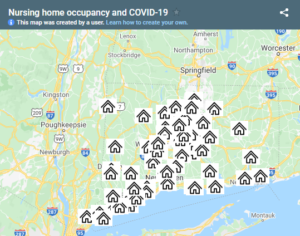
Medicare chief says “significant deficiencies in infection control practices” in nursing homes have doubled weekly COVID-19 cases, but “this isn’t a time of fines and being punitive.”
Category: Medicare
House Committee Approves Bill to Ease Medicare Part B Enrollment
Seniors would be notified about eligibility to avoid late fees, coverage gap
Hundreds Died of COVID at NYC Nursing Homes With Spotless Infection Inspections
By Susan Jaffe | THE CITY | May 27, 2020 
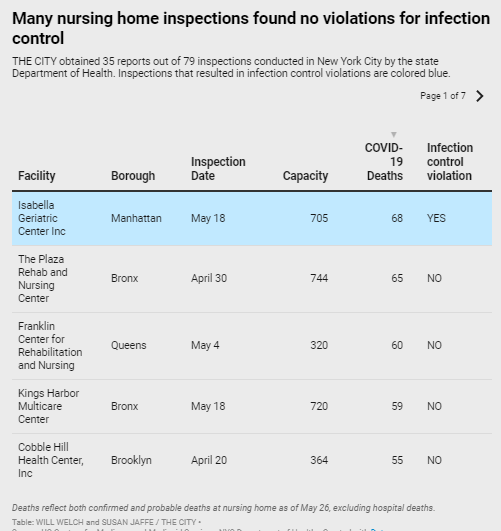
More than 600 residents have died from COVID-19 at 25 New York City nursing homes that received clean bills of health for controlling the spread of infections, state Department of Health inspection reports obtained by THE CITY show.
Those facilities inclu
de homes with some of the highest coronavirus death tolls in the nation — including the Sapphire Center for Rehabilitation and Nursing in Flushing, which reports 54 residents died of confirmed or presumed COVID….
At the Franklin Center for Rehabilitation and Nursing, also in Flushing, 60 residents — nearly one in five — succumbed to the virus. Its May 4 inspection report found no problems.
Also passing its May 11 infection-control inspection was New York State Veterans Home in St. Albans, Queens. Staff there previously told THE CITY that the state Health Department-run home failed to separate COVID-positive and uninfected residents, something that was a violation at other facilities….
“It’s very shocking that at the apex of this pandemic, our inspectors went in and reported that that there’s nothing out of the ordinary when it’s clear that the infection rate had spread,” said Assemblymember Ron Kim (D-Queens), whose district includes Sapphire and the Franklin Center. [continued here].
…Federal Judge Rules Medicare Patients Can Challenge ‘Observation Care’ Status
By Susan Jaffe | Kaiser Health News | March 30, 2020| This story also appeared in 
Hundreds of thousands of Medicare beneficiaries who have been denied coverage for nursing home stays because their time in the hospital was changed from “inpati
ent” to “observation care” can now appeal to Medicare for reimbursement, a federal judge in Hartford, Connecticut, ruled last week.
If the government does not challenge the decision and patients win their appeals, Medicare could pay them millions of dollars for staggeringly high nursing home bills….
“If I had gone home, I would have died,” said Ervin Kanefsky, 94, a plaintiff [in a class action lawsuit against Medicare] from suburban Philadelphia. He was admitted to the hospital as an inpatient after fracturing his shoulder in a fall. When he was about to leave after five days to recuperate at a nursing home, a hospital official told him his status had changed to observation. With one arm in a sling, stitches in the other and unable to hold onto his walker, he learned Medicare wouldn’t pay for the nursing home. [Continued at Kaiser Health News or The Philadelphia Inquirer.]
…Coronavirus Stresses Nursing Home Infection-Control Practices
I-TEAM IN-DEPTH | CONNECTICUT HEALTH INVESTIGATIVE TEAM | MARCH 12,2020

As coronavirus cases increase, posing heightened risks to the elderly, nursing homes will face growing scrutiny from state health inspectors.
In Connecticut and nationally, complying with federal infection-control requirements is a challenge for some nursing homes. Between 2017 and 2019, 145 of Connecticut’s 217 nursing homes – or about 67 percent – were cited for infection-control violations, according to a Conn. Health I-Team analysis of data from the Centers for Medicare & Medicaid Services (CMS). [Continued here, with list of nursing home infection violations.]
…
Medicare for All scrutinised in Democratic primaries
![]()
Volume 395 Number 10225 29 February 2020
WORLD REPORT On March 3, 14 states will pick their nominees for the US presidential election. The feasability of a single payer insurance plan is a key issue. Susan Jaffe reports from Washington, DC.
Anxiety about rising health-care costs— the top issue for Democratic voters, according to recent polls—propelled Bernie Sanders to the head of the pack in last week’s Democratic primary contest in Nevada. Of the six leading candidates vying for the party’s presidential nomination, Sanders, a Vermont senator and self-described democratic socialist, has proposed the most radical solution for lowering medical bills and reaching universal coverage. His signature policy initiative, the Medicare for All single-payer programme, would eliminate private health insurance, including employment-based plans that cover about half of the US population. [Article compares Medicare for All and the public option proposal favoured by former Vice President Joe Biden; continued here]
Congress Considers Bill to Address Medicare Late Penalties, Coverage Gap
Current enrollment rules can leave late enrollees liable for doc visits Medicare usually covers
Legislation that would fix these problems was one of the bills discussed at a hearing held by the House Energy & Commerce Health Subcommittee…. Although the panel focused on how the bipartisan Beneficiary Enrollment Notification and Eligibility Simplification (BENES) Act impacts Medicare patients, it also affects their physicians. [Continued here and PDF here]
Website Errors Raise Calls For Medicare To Be Flexible With Seniors’ Enrollment
Seniors will be able to change plans any time next year if they discover their coverage doesn’t provide what the government’s Plan Finder promised.
By Susan Jaffe | Kaiser Health News | December 6, 2019 | This article also ran on 
Saturday is the deadline for most people with Medicare coverage to sign up for private drug and medical plans for next year. But members of Congress, heal
th care advocates and insurance agents worry that enrollment decisions based on bad information from the government’s revamped, error-prone Plan Finder website will bring unwelcome surprises.
Beneficiaries could be stuck in plans that cost too much and don’t meet their medical needs — with no way out until 2021.
On Wednesday, the Centers for Medicare & Medicaid Services told Kaiser Health News that beneficiaries would be able to change plans next year because of Plan Finder misinformation, although officials provided few details. [Continued at Kaiser Health News or NPR.] …
As Medicare Enrollment Nears, Popular Price Comparison Tool Is Missing
By Susan Jaffe | Kaiser Health News | October 8, 2019 | This article also ran in the
Millions of older adults can start signing up next week for private policies offering Medicare drug and medical
coverage for 2020. But many risk wasting money and even jeopardizing their health ca
re due to changes in Medicare’s plan finder, its most popular website.
For more than a decade, beneficiaries used the plan finder to compare dozens of Medicare policies offered by competing insurance companies and get a list of their options. Yet after a website redesign six weeks ago, the search results are missing crucial details: How much will you pay out-of-pocket? And which plan offers the best value? [Continued at Kaiser Health News, San Francisco![]()
Class-Action Lawsuit Seeks To Let Medicare Patients Appeal Gap in Nursing Home Coverage
By Susan Jaffe | Kaiser Health News | August 12, 2019 | This KHN story also ran on Salon and Next Avenue
Medicare paid for Betty Gordon’s knee replacement surgery in March, but the 72-year-old former high school teacher needed a nursing home stay and care at home to recover.
![]()
Yet Medicare wouldn’t pay for that. So Gordon is stuck with a $7,000 bill she can’t afford — and, as if that were not bad enough, she can’t appeal.

The reasons Medicare won’t pay have frustrated the Rhode Island woman and many others trapped in the maze of regulations surrounding something called “observation care.”
Patients, like Gordon, receive observation care in the hospital when their doctors think they are too sick to go home but not sick enough to be admitted. They stay overnight or longer, usually in regular hospital rooms, getting some of the same services and treatment (often for the same problems) as an admitted patient….

(Photo courtesy of Betty Gordon)
But observation care is considered an outpatient service under Medicare rules, like a doctor’s appointment or a lab test. Observation patients may have to pay a larger share of the hospital bill than if they were officially admitted to the hospital.Medicare’s nursing home benefit is available only to those admitted to the hospital for three consecutive days. Gordon spent three days in the hospital after her surgery, but because she was getting observation care, that time didn’t count.

There’s another twist: Patients might want to file an appeal, as they can with many other Medicare decisions. But that is not allowed if the dispute involves observation care.
Monday, a trial begins in federal court in Hartford, Conn., where patients who were denied Medicare’s nursing home benefit are hoping to force the government to eliminate that exception. A victory would clear the way for appeals from hundreds of thousands of people. [Continued at Kaiser Health News, Next Avenue or Salon]
…Social Security Error Jeopardizes Medicare Coverage For 250,000 Seniors
By Susan Jaffe | Kaiser Health News | June 6, 2019 | This KHN story also ran on 
At least a quarter of a million Medicare beneficiaries may receive bills for as many as five months of premiums they thought they already paid.
But they shouldn’t toss the letter in the garbage. It’s not a scam or a mistake.
Because of what the Social Security Administration calls “a processing error” that occurred in January, it did not deduct premiums from some seniors’ Social Security checks and it didn’t pay the insurance plans.
[Continued at Kaiser Health News or NPR ]
…Home Health Care Providers Struggle With State Laws And Medicare Rules As Demand Rises
“We can send prescriptions to the pharmacy, including [for] narcotics,” says Marie Grosh, a geriatric advanced practice nurse practitioner and the owner of a medical house calls practice in a Cleveland suburb. “We can order lab work, x-rays, ultrasounds, EKGs [electrocardiagrams]; interpret them; and treat patients based on that. But we’re just not allowed to order home care—which is absurd.”
By SUSAN JAFFE | Health Affairs | June 2019 | Volume 38, Number 8
When Christine Williams began working as a nurse practitioner some forty years ago in Detroit, Michigan, older adults who couldn’t manage on their own and had no family nearby and no doctor willing to make house calls had few options besides winding up in a nursing home.
Not anymore.

Home check: Nurse practitioner Marie Grosh visits Leroy Zacharias at his home in a Cleveland suburb, He has Parkinson disease, and Grosh says he would be living in a nursing home if he couldn’t get medical care at home. (Photo by Lynn Ischay.)
“The move towards keeping seniors in their homes is a fast-galloping horse here,” says Williams, who settled in Cleveland, Ohio, more than a decade ago. “We don’t have space for them in long-term care [facilities], they don’t want to be in long-term care, and states don’t want to pay for long-term care. And everybody wants to live at home.”
But despite the growing desire for in-home medical care for older adults from nearly all quarters, seniors’ advocates and home health professionals claim that rules set by the Centers for Medicare and Medicaid Services (CMS) along with state regulations have created an obstacle course for the very providers best positioned—and sometimes the only option—to offer that care. [Continued here] …
Legal battles over abortion heat up in the USA
Volume 393 Number 10184 11 May 2019
WORLD REPORT Changes to Title X, several legal challenges, and a change to the Supreme Court composition could mean drastic changes for access to abortion in the USA. Susan Jaffe reports.
“We are the department of life…from conception until natural death, through all of our programmes”, US Department of Health and Human Services (HHS) secretary Alex Azar said earlier this year…. The government’s anti-abortion efforts have ignited lawsuits from Maine to California. Eventually, one or more of these cases are expected to reach the Supreme Court. With its newest arrival—Justice Brett Kavanaugh, whose nomination by Trump was championed by abortion opponents—the Supreme Court’s ideological balance has now shifted towards a conservative majority [raising] opponents’ hopes that a sympathetic court will diminish, if not overturn, Roe v. Wade...
Late last week, lawyers for the HHS appealed decisions by two federal court judges in Oregon and Washington state to temporarily halt new administration rules that would limit the information about abortion services that federally funded health-care providers can tell their patients.
“We are fighting back in the courts, we are fighting back in Congress and in state legislatures all across the country”, said Planned Parenthood president Leana Wen, noting that one in four women in the USA will have an abortion in their lifetime. “The public is with us when it comes to defending access to safe legal abortion, which people understand is part of the full spectrum of reproductive health care, which is health care.” [Continued here.]…
House Drug Price Hearing Takes Aim at Industry
By Susan Jaffe | Contributing Writer | MedPageToday | January 30, 2019
WASHINGTON — Pharmaceutical companies were pummeled during Tuesday’s hearing of the House Committee on Oversight and Reform. The panel’s first hearing of the 116th Congress examined the reasons for rising drug prices and follows committee chairman Elijah Cummings’ (D-Md.) launch of an aggressive investigation into pharmaceutical pricing issues.
“For the past decade I’ve been trying to investigate the actions of drug companies for all sorts of drugs — old and new, generic and brand name,” Cummings said. “We have seen time after time drug companies make money hand over fist by raising the prices of their drugs often without justification…” [Continued at MedPageToday]
State exemptions to the Affordable Care Act expanded
Volume 392, Number 10164
15 December 2018
WORLD REPORT In its latest blow to the ACA, the Trump administration provides guidance on how states can circumvent the health law. Susan Jaffe, The Lancet‘s Washington correspondent, reports.
Trumpeted New Medicare Advantage Benefits Will Be Hard For Seniors To Find
By Susan Jaffe | Kaiser Health News | November 9, 2018 | This KHN story also ran on 
For some older adults, private Medicare Advantage plans next year will offer a host of new benefits, such as transportation to medical appointments, home-delivered meals, wheelchair ramps, bathroom grab bars or air conditioners for asthma sufferers.
But the new benefits will not be widely available, and they won’t be easy to find.
Of the 3,700 plans across the country next year, only 273 in 21 states will offer at least one. About 7 percent of Advantage members — 1.5 million people — will have access, Medicare officials estimate.
That means even for the savviest shoppers it will be a challenge to figure out which plans offer the new benefits and who qualifies for them.


Medicare officials have touted the expansion as historic and an innovative way to keep seniors healthy and independent. Despite that enthusiasm, a full listing of the new services is not available on the web-based “Medicare Plan Finder,” the government tool used by beneficiaries, counselors and insurance agents to sort through dozens of plan options. [Continued at Kaiser Health News, NPR and CNN]…
No More Secrets: Congress Bans Pharmacist ‘Gag Orders’ On Drug Prices
Update: After this article was posted Oct. 10th, the President signed the legislation into law later that day.
By Susan Jaffe | Kaiser Health News | October 10, 2018 | This KHN story also ran on 
For years, most pharmacists couldn’t give customers even a clue about an easy way to save money on prescription drugs. But the restraints are coming off.

When the cash price for a prescription is less than what you would pay using your insurance plan, pharmacists will no longer have to keep that a secret.
…But there’s a catch: Under the new legislation, pharmacists will not be required to tell patients about the lower cost option. If they don’t, it’s up to the customer to ask. [Continued at Kaiser Health News and at NBC News]
…New Medicare Advantage Tool To Lower Drug Prices Puts Crimp In Patients’ Choices
Some physicians and patient advocates are concerned that the pursuit of lower Part B drug prices could endanger very sick Medicare Advantage patients if they can’t be treated promptly with the medicine that was their doctor’s first choice.
By Susan Jaffe | Kaiser Health News | September 17, 2018 | This KHN story also ran on 
Starting next year, Medicare Advantage plans will be able to add restrictions on expensive, injectable drugs administered by doctors to treat cancer, rheumatoid arthritis, macular degeneration and other serious diseases.
Under the new rules from Medicare, these private Medicare insurance plans could require patients to try cheaper drugs first. If those are not
effective, then the patients could receive the more expensive medication prescribed by their doctors.
Insurers use such “step therapy” to control drug costs in the employer-based insurance market as well as in Medicare’s stand-alone Part D prescription drug benefit, which generally covers medicine purchased at retail pharmacies or through the mail. The new option allows the private Medicare plans — an alternative to traditional, government-run Medicare — to extend that cost-control strategy to these physician-administered drugs.
…Critics of the new policy, part of the administration’s efforts to fulfill President Donald Trump’s promise to cut drug prices, say it lacks some crucial details, including how to determine when a less expensive drug isn’t effective. [Continued at Kaiser Health News and NPR]
…
Prospects for US single-payer national health care
Volume 392, Number 10149
1 September 2018
WORLD REPORT The single-payer national health-care bill, so-called Medicare for All, is gaining momentum with the public but is stalling in Congress. Susan Jaffe, The Lancet‘s Washington correspondent, reports.
…
Trump Administration’s Medicaid work rules hit a snag
Susan Jaffe | Washington Correspondent for The Lancet | 10th July 2018
After winning a federal court decision to stop Kentucky from requiring some Medicaid patients find paid or volunteer work to keep their coverage, beneficiary advocates are considering legal challenges to stop similar efforts in other states.
The victory may expose a major flaw in the Trump Administration’s effort to reshape the Medicaid program, advocates say. But others claim the flaw is in the court decision. [Continued here.]…


Looking For Lower Medicare Drug Costs? Ask Your Pharmacist For The Cash Price.
Sometimes a drug plan’s copay is higher than the cash, but insurers’ “gag orders” keep pharmacists from telling Medicare beneficiaries. A little-known Medicare rule requires pharmacists to divulge the lower cash price if patients ask.
By Susan Jaffe | Kaiser Health News | May 30, 2018 | This KHN story also ran on 
As part of President Donald Trump’s blueprint to bring down prescription costs, Medicare officials have warned insurers that “gag orders”

Scott Olson/Getty Images
keeping pharmacists from alerting seniors that they could save money by paying cash — rather than using their insurance — are “unacceptable and contrary” to the government’s effort to promote price transparency.
But the agency stopped short of requiring insurers to lift such restrictions on pharmacists.
That doesn’t mean people with Medicare drug coverage are destined to overpay for prescriptions. Under a little-known Medicare rule, they can pay a lower cash price for prescriptions instead of using their insurance. But first, they must ask the pharmacist about that option…. [Continued at Kaiser Health News, NPR and CNN Money]…
Medicare Advantage Plans Cleared To Go Beyond Medical Coverage — Even Groceries
By Susan Jaffe | Kaiser Health News | April 3, 2018 | This KHN story also ran on 
Air conditioners for people with asthma, healthy groceries, rides to medical appointments and home-delivered meals may be among the new benefits added to Medicare Advantage [private insurance] coverage when new federal rules take effect next year.

The Institute for Aging in San Francisco helps seniors get to doctor appointments and social activities. (Photo/Susan Jaffe)
…But patient advocates including David Lipschutz. senior policy attorney at the Center for Medicare Advocacy, are concerned about those who may be left behind. “It’s great for the people in Medicare Advantage plans, but what about the majority of the people who are in traditional Medicare?” he asked. “As we tip the scales more in favor of Medicare Advantage, it’s to the detriment of people in traditional Medicare.” [Continued at Kaiser Health News, The Philadelphia Inquirer, The Washington Post and CNN Money]
…Lifting Therapy Caps Is A Load Off Medicare Patients’ Shoulders
Last month’s budget deal means Medicare beneficiaries are eligible for physical and occupational therapy indefinitely. Plus, prescription drug costs will fall for more seniors.
By Susan Jaffe | Kaiser Health News | March 14, 2018 | This KHN story also ran on 
Physical therapy helps Leon Beers, 73, get out of bed in the morning and

Leon Beers gets help from caregiver Timothy Wehe. (Bert Johnson for KHN)
maneuver around his home using his walker. Other treatment strengthens his throat muscles so that he can communicate and swallow food, said his sister Karen Morse. But in mid-January, his home health care agency told Morse it could no longer provide these services because he had used all his therapy benefits allowed under Medicare for the year.
… Under a recent change in federal law, people who qualify for Medicare’s [physical, occupational and speech] therapy services will no longer lose them solely because they used too much.
“It is a great idea,” said Beers. “It will help me get back to walking.” [Continued at Kaiser Health News, NPR and The Washington Post]
…
Home Care Agencies Often Wrongly Deny Medicare Help To The Chronically Ill
By Susan Jaffe | Kaiser Health News | January 18, 2018 | This KHN story also ran on 

Colin Campbell (Heidi de Marco/KHN)
Colin Campbell needs help dressing, bathing and moving between his bed and his wheelchair. He has a feeding tube because his partially paralyzed tongue makes swallowing “almost impossible,”he said.
Campbell, 58, spends $4,000 a month on home health care services so he can continue to live in his home just outside Los Angeles. Eight years ago, he was diagnosed with amyotrophic lateral sclerosis, or “Lou Gehrig’s disease,” which relentlessly attacks the nerve cells in his brain and spinal cord and has no cure.
The former computer systems manager has Medicare coverage because of his disability, but no fewer than 14 home health care providers have told him he can’t use it to pay for their services. That’s an incorrect but common belief…. [Continued at Kaiser Health News and NPR]…
A Few Pointers To Help Save Money And Avoid The Strain Of Medicare Enrollment
By Susan Jaffe | Kaiser Health News | Oct. 17, 2017 | This article also ran in
and ![]()
noticed an uptick in mail solicitations from health insurance companies, which can mean only one thing: It’s time for the annual Medicare open enrollment.